

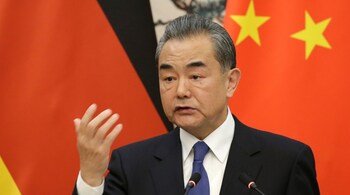
The replacement of Qin Gang as minister was not the only change that took place in China’s ministry of foreign affairs this week. The appointment of a new minister is like a routine cabinet reshuffle, which happens in every country from time to time. Inevitably, interpretations of such changes by pundits follow. China has been no exception. But some of the other changes in the Chinese foreign ministry have been bizarre, yet unnoticed in the worldwide excitement over bringing back “Silver Fox” Wang Yi as foreign minister on July 25. Wang is so nicknamed because of his silver hair and wily talents.
The ministry now emphasises the sex and ethnicity of its spokespersons. Mao Ning, the most articulate of the three public faces of China’s global engagement, is now described in her brief biography as “female, Han ethnicity”. It is like officially describing KC Singh, who was spokesman of the ministry of external affairs (MEA) at the time of the Pokhran II nuclear tests as “Sikh”. Or formally notifying that Navtej Sarna, who was the longest-serving MEA Spokesman, is a “Punjabi”. Wang Wenbin, the older and less opaque face of his ministry is described as “born in April 1971. Graduated with a master’s degree in economics. Member of the CPC”. The acronym stands for the Communist Party of China. Imagine the MEA publicly declaring upon the appointment of civil servant Raveesh Kumar, who was the ministry’s spokesman during three years of the Narendra Modi government, as a “member of the Bharatiya Janata Party”. Hypothetically speaking, since Kumar is not a BJP member by any public reckoning.
It's Not Official, Yet
Equally bizarre is that China’s foreign ministry, till the time this is published, has not recognised the appointment of Wang as the new foreign minister. His predecessor Qin’s removal from the post, however, has been acknowledged. On the ministry’s official website, the minister’s job is not even shown as “vacant”. It says the position is “updating”. Such a situation is unprecedented since the internet was invented, although China has had six foreign ministers in the new millennium. It is reminiscent of the chaotic years of the Great Proletarian Cultural Revolution in the decade that spanned the mid-1960s to the mid-1970s when decisions of the state were pasted on public walls of Beijing’s streets and often contradicted one another in quick succession.
These suggest a bigger turmoil in China’s foreign affairs than what missing names or weird official biographies convey. It is a cause for worry at a time when China and the United States of America are attempting to reset their troubled relations, and when China’s increased activism over the situation in Ukraine in recent weeks can impact the world. It is a cause for worry for India too, with an unstable border and confusing signals from both capitals about bilateral investments.
It is virtually certain that when Wang met national security adviser Ajit Doval in Johannesburg on July 24, he knew that he would take up charge as foreign minister within 24 hours, in addition to his continuing responsibilities as Politburo member and director of the CPC Central Committee’s Foreign Affairs Commission. His is now the last word on his country’s foreign policy: President Xi Jinping is known to trust Wang’s judgement over the long years that he has held several top foreign affairs positions in China’s state and party apparatus. Chinese reportage of Wang’s meeting with Doval has been more exhaustive than Indian coverage. “India is willing to work with China in a spirit of mutual understanding and mutual respect to find a fundamental solution to the border issues and improve their bilateral relations in a timely manner, so as to make positive contributions to world peace and prosperity,” the Chinese side quoted Doval as having told Wang. It typifies a traditional Confucian approach: Confucius said in one of his memorable quotes that “it does not matter how slowly you go so long as you do not stop”. This is in line with what Wang told his interlocutors when he visited India in March last year as foreign minister.
According to an Indian official statement on the Johannesburg meeting, bridging the trust deficit between both sides is very important. The Indian “National Security Advisor conveyed that the situation along the Line of Actual Control in the Western Sector of the India-China boundary since 2020 had eroded strategic trust and the public and political basis of the relationship. NSA emphasised the importance of continuing efforts to restore peace and tranquility in the border areas”.
Salacious Stories
Meanwhile, Washington’s “Beltway” rumour mill has been working overtime with salacious stories about the reasons for Qin’s ouster. Some of the stories – with even photos in circulation, but beyond verification – relate to the time he was Ambassador in Washington on an unusually short tenure of just over two years. Recently, China’s foreign ministry spokesperson Mao Ning was asked about an alleged extra-marital affair by Qin during his Washington tenure. Mao denied any knowledge of such a scandal with a characteristically bland expression.
Taking all factors into account, Wang’s assumption of the foreign minister’s job is likely to be a stopgap arrangement. His two high-level CPC jobs give him veto power over decisions made by China’s foreign ministry in any case. That being the case, what Beijing needs is a successor to Qin for a largely ceremonial role of receiving foreign counterparts or acting as a messenger or postman to President Xi. China has eight designated “Principal Officials” in the foreign ministry who could be groomed in the coming months to become foreign minister. Wang and Xi are likely to test their mettle to see who among them could be the permanent successor to the ousted minister.
KP Nayar has extensively covered West Asia and reported from Washington as a foreign correspondent for 15 years. Views are personal, and do not represent the stand of this publication.
Discover the latest Business News, Sensex, and Nifty updates. Obtain Personal Finance insights, tax queries, and expert opinions on Moneycontrol or download the Moneycontrol App to stay updated!





