

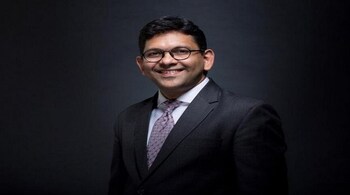
The very nature of the market is to fluctuate, whether there is COVID or not. Generally, once every three years, the market falls and then there is an upward journey. So, the inherent nature of market volatility will remain but intensity of volatility could be higher than what we witness in normal times, says Kalpen Parekh, President, DSP Investment Managers in an interaction with Moneycontrol's Swati Verma.
Kalpen has around 23 years of experience in sales across client segments, distribution and marketing. He was previously Managing Director and Head of Sales & Marketing at IDFC Mutual Fund. He has also served in Birla Sun Life Asset Management Company Limited and ICICI Prudential Asset Management Company Limited after beginning his career with L&T Finance Ltd.
Edited excerpts:
The second wave of COVID-19 in India has been devastating. We are witnessing restrictions, lockdowns all over again. Given this scenario, what's your view on the current market?
We are witnessing a once-in-a-century pandemic and none of us has lived through that. This is the first time that all of us are getting exposed to a pandemic - its health effect, social effect, as well as economic impact. Also, history shows that pandemics do not end in one wave. There are a series of waves. Currently, we are witnessing the second wave and there could be one or two more waves. Nobody can predict the future. At the same time, with passage of time, vaccinations will help us reduce impacts of future waves hopefully. As regards markets, phases of ups and downs will continue.
We will continue to face bouts of uncertainty - both positive (easy liquidity, low interest rates) and negative (sharp spike in infections, increased curbs and lockdowns) for the next one-two years. More so, as recent earnings upcycle makes equities positive, at the same time, higher valuations and chances of rates and inflation rising would be concerns. We must realise the very nature of the market is to fluctuate, whether there is COVID or not. Generally, once every three years, the market falls and then there is an upward journey. So, the inherent nature of market volatility will remain but intensity of volatility could be higher than what we witness in normal times.
What's your take on the current valuations of the market?
Valuation is a component of two parts - price of the stocks and companies' earnings, in fact, speed of the earnings growth. Data shows that the speed of earnings has been much slower in the decade of 2010 to 2020 than the decade of 2000-2010.
During 2000-2010, India's GDP growth was at 8-10 percent and profit growth was about 20 percent for 5 years in a row and, on an average, valuations at 17-18 times of these rising earnings. However, in the next decade (2010-2020), GDP growth came down to 4-6 percent, which reflected in corporate profitability, that grew at half the rate -- 8-10 percent. However, stocks didn’t react to slowing profits and continue to remain optimistic thus keeping valuations high. On the other hand, because of the liquidity the world over and significantly low interest rates globally, including India, more and more money is chasing stocks and hence, valuations have been close to 25 times instead of 17-18 times. But time and again, higher valuations indicate the assumption that growth rates will inflect up again basis various policy actions everywhere. But whether that will happen in a hurry or not is unclear.
Your advice to investors.
Investors should stay fairly disciplined and prudent in an environment like this. Generally, when valuations are higher than their long-term averages, there are some approaches that I would recommend, which I personally follow. The first is to increase the time horizon and moderate return expectations. Second, align return expectations with real rates. Third, use more of hybrid and asset allocation funds. Lastly, when the price is on a higher side, the best investment approach is SIPs as a technique to acquire units over the next 2-3 or 5 years which can help one steadily navigate through phases of volatility and uncertainty.
Have you revised down your earnings estimates for FY22?
It's a bit too early to comment on it because we just have partial lockdowns in some pockets right now. So, we really have to wait and watch whether this gets stretched further to more areas.
Last year, what helped corporate profitability was significant reduction in expenses. Travel-costs, office costs, rental costs came down significantly. So, profitability improved because margins improved. If this trend continues, we should see more stability in stock prices.
Investors are returning to equity mutual funds after a gap of eight months. How do you interpret this development?
When the markets crashed last year, investors pressed the panic button which resulted in huge redemption from existing investors either in want of cash due to anxiety and uncertainty on their jobs and their businesses front or due to extreme volatility. So, redemptions negated the inflows. Now, new inflows are coming in as they were in the last year but redemptions, which were on a rise for the past eight months, are slowing down significantly and we believe this trend should continue unless we see very large extension of COVID waves and lockdowns.
Normally, when markets rise very sharply, in the first round, redemptions increase but then it settles down and consolidates. Even investors want to stay invested, it is only the volatility that unnerves them.
Tell us about DSP Mutual Fund’s investment strategy and new product offerings in the pipeline.
In DSP Value Fund, We select companies with few of these criteria: good balance sheet, good governance, good management, stable return on equity (ROE), low cost of capital, and have very low leverage. In short, companies which are long-lasting, where management interests are aligned with shareholders' interest, where accounting is clean, they are good companies.
Now, in this set of companies, if their operating metrics are so good, most companies would be high on valuations too. The Value fund eliminates such companies which are most expensive to its history and peers and the rest of the universe then gets scored for selection. We construct 65% of our portfolio from above companies. The balance 35% of the portfolio is diversified globally via international stocks/funds. In some way, the largest weight in Indian equity funds belongs to lenders (~ 35%). We are replacing this weight to lenders with global stocks thus creating a very unique and complimentary portfolio for investors.
The largest weight in our international exposure is Berkshire Hathaway which is managed by one of the best capital allocators in the world. Our second holding is Lindsell Train, which is again, a long-term oriented value investor investing across Europe, UK and Japan among others. Some of these styles have been less popular in last decade due to most of the returns polarised by tech businesses and we felt this is a good time to own less popular styles and names.
Value mutual funds have witnessed growth due to a rally in value stocks in the stock markets. What are your views on the sustenance of this category?
Value investment is a long-term profitable investment style. Some of the most iconic investors in the world have managed large amounts of money for a long period of time by using value investment as a style. Our confidence in it is reflected in the fact that in December we launched a value fund. So, we are very confident with value as a style of investing, provided one’s time horizon is long.
The important thing is how do you define value investing because different people have different views on it. A basic first condition for all our portfolios is the quality of business and management. Having established this, then we look at relatively cheaper valuations either due to sector being under owned or temporary bad news for the company/sector. In today’s excess-liquidity world, not many good companies would be very cheap, and we recognise this. There are cycles in investing, and market preferences keep changing. There are times markets love only fast-growing companies and sectors irrespective of them being priced to perfection. Any disappointments or turn in cycle, leads to sharp corrections in such growth companies. On the other hand, many cheap companies are deservingly cheap and investing in them only for cheapness can lead to disappointing long-term returns.
Sectors that look promising.
Engineering sector. The capex side of the economy has not done well over the last 12-13 years and a lot of these companies have improved their balance sheets, almost minimised their debt or leverage - whether it is cement, industrials or engineering. That segment is looking promising. Our Tiger fund is designed to capture this theme.
Secondly, the trends for digitisation will continue to strengthen at least in the near-to-medium-term, thanks to fast-tracking of digitisation the world over. So, while these stocks have run up, but in terms of profitability, their prospects look stable. We are overweight on healthcare, technology, insurance, cement and select banks and NBFCs.
Sectors to avoid.
We eliminate those stocks which don't have inherently sustainable return on equity and these are across sectors.
Any company which does not have higher RoE than the cost of capital, generally we don't see value in it. For example, if borrowing costs of company is 7-8% in today's environment, and ROEs are not 15-16%, in the long run, these firms don't create wealth. So, you look for stable RoE companies or higher RoE companies. We do take exceptions, where companies and sectors are improving from lower to higher RoEs and tactically take advantage of such transitions (eg - telecom, select corporate banks etc)
Trends in MF industry.
The penetration of MF industry in the country is still less than 10 percent. So, there is a large room to grow year after year. The fund industry in India is well-regulated and very transparent. Mutual funds offer cost and tax efficient ways of investing across all asset classes - stocks, bonds, Gold, international companies.
Our reach to consumers is enhanced by the digital adoption in the country thus making every smart phone and bank account holder accessible to us. We have to continue to convert a country of savers into long-term investors. Markets fluctuate every few years and making our investors aware and prepare for temporary fluctuations and help them invest right and for long term is a very large opportunity for all of us.
Discover the latest Business News, Sensex, and Nifty updates. Obtain Personal Finance insights, tax queries, and expert opinions on Moneycontrol or download the Moneycontrol App to stay updated!





