

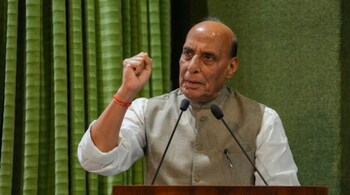
Defence Minister Rajnath Singh’s remark that "borders can change" and the Sindh region may return home to India has once again brought back the focus to one of the most controversial aspects of the 1947 Partition.
His comments come at a time when relations between the two countries remain tense following military hostilities during Operation Sindoor in May.
Speaking at the Sindhi Samaj Sammelan in New Delhi on Sunday, Singh said, “Today, the land of Sindh may not be a part of India, but civilisationally, Sindh will always be a part of India. And as far as land is concerned, borders can change. Who knows, tomorrow Sindh may return to India again.”
He highlighted the sacred significance of the Indus River for Hindus across India and even for many Muslims in Sindh, who revered its waters as comparable to Mecca's Aab-e-Zamzam.
Singh also quoted BJP veteran LK Advani’s writing on Sindh, now part of Pakistan since the 1947 Partition.
Advani, who was born in Sindh, wrote in his books that Sindhi Hindus of his generation never emotionally accepted the separation.
"I'd also like to mention the Lal Krishna Advani here. He wrote in one of his books that Sindhi Hindus, especially those of his generation, still haven't accepted the separation of Sindh from India. Not just in Sindh, but throughout India, Hindus considered the Indus River sacred. Many Muslims in Sindh also believed that the water of the Indus was no less sacred than the Aab-e-Zamzam of Mecca. This is Advani's quote," he said.
History of Sindh
Sindh, Gujarat, and Maharashtra were all a part of Bombay Province until 1936. However, Muslims and Hindus in Sindh together spearheaded a campaign to establish it as a distinct province. Due to the Marathi and Gujarati populations' prominence, residents of Sindh felt that their rights and customs were being disregarded.
A Hindu by the name of Harchandrai first called for a separate Congress legislature for Sindh in 1913. In 1938. Muhammad Ali Jinnah formally demanded that Muslims have their own nation, Pakistan, during the Muslim League's annual meeting in Karachi.
What happened in 1947?
When the dividing line of the 1947 Partition was drawn, Sindh was given in its entirety to Pakistan. The historic Sindh region, which is known as the centre of the Indus Valley civilization, also consists of Thar desert. It is bordered by the provinces of Balochistan on the west and north, Punjab on the northeast, the Indian states of Rajasthan and Gujarat to the east, and the Arabian Sea
to the south.
According to the 1931 Census, Sindh had about 4.1 million people. About 73 percent were Muslims, 26 percent were Hindus, and 1 percent belonged to other religions, mainly Christianity and Sikhism.
During Partition, Sindh, unlike Punjab and Bengal, was not partitioned demographically. The entire state went to Pakistan.
It caused widespread migration and instability.
While the indigenous Sindhi Muslims did not entirely welcome the new Indian Muslims, many middle-class Hindus left Sindh for India. However, Muhajirs were instrumental in building the foundations of the Pakistani state. As political power became centralised in the hands of the Punjabi military elite and Sindhi political class, the Muhajirs found themselves increasingly sidelined.
According to reports, nearly 16 million Muhajirs, which comprises approximately 7.6 per cent of Pakistan’s population, reside in urban Sindh. However, they remain politically voiceless and poor. In 1992, according to reports by Human Rights Watch and Amnesty International, between 2,000 and 3,000 Muhajirs were killed.
Throughout the 1990s and 2000s, the Pakistani media imposed a near-total blackout on Muhajir persecution. In 2023 alone, more than 1,200 social media accounts were suspended for raising concerns about Muhajir disappearances or criticising the military, according to News18.
Sindh leader backs Singh
Shafi Burfat, Chairman of the Jeay Sindh Muttahida Mahaz (JSMM), welcomed Singh’s remark and reiterated that Sindh remains open to forming a confederation with India, based on mutual respect, sovereignty, and the shared historical, cultural, and civilisational ties, citing continued repression in Pakistan.
“… in light of Shri Rajnath Singh’s address today, JSMM affirms once again that Sindhudesh is open to the idea of establishing a confederation with India, based on mutual respect, sovereignty, and the shared historical, cultural, and civilizational ties between the Sindhi nation and the Indian subcontinent,” said Burat in a post on X.
According to Burat, Singh’s remark has “generated profound encouragement and a renewed sense of assurance for the freedom and future of the Sindhi nation”. “…We express this hope with sincerity: that such a moral and political foundation will also be echoed by the Honourable Prime Minister of India, Shri Narendra Modi. His endorsement would shine further light upon the aspirations of the Sindhi nation,” he said.
Pakistan slams Rajnath Singh
On the other hand, the Ministry of Foreign Affairs of Pakistan condemned Singh’s remarks and as “delusional” and “dangerously revisionist”.
“Such statements reveal an expansionist Hindutva mindset that seeks to challenge established realities and stand in clear violation of international law, the inviolability of recognized borders, and the sovereignty of states,” the statement said.
The ministry also urged Singh and other India leaders to “refrain from provocative rhetoric that threatens regional peace and stability”. “Pakistan remains committed to peaceful resolution of all disputes with India on the basis of justice, equity and established international legal norms. At the same time, as in the past, Pakistan is firmly resolved to safeguard its security, national independence and sovereignty,” it said.
Discover the latest Business News, Sensex, and Nifty updates. Obtain Personal Finance insights, tax queries, and expert opinions on Moneycontrol or download the Moneycontrol App to stay updated!





