

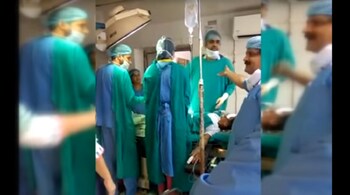
Aravind (name changed), 26, a fresh MBBS graduate who passed out this year, has landed up at the COVID-19 ward as a duty doctor of an 80-bed private hospital in Eluru town, the headquarters of West Godavari district, Andhra Pradesh.
He is earning Rs 2,500 per day, having chosen a private hospital over a government facility because of better pay and working conditions.
"This is a new disease, we are learning," Aravind told Moneycontrol. Aravind said his experience of working in COVID ward last year as undergraduate is helping him this year.
"There is a lot of exhaustion both physically and mentally, as we see a lot of death and suffering, but we are getting used to it," Aravind said.
Aravind is among, 4,500 graduates who have passed out in Andhra Pradesh in 2021, many of whom were deployed in COVID-19 wards by both government and private hospitals, as cases surged.
Andhra Pradesh isn't alone. Every year, 1,50,000 students across India pass out of MBBS degree programmes. Most states are using the services of MBBS doctors who are straight out of medical schools to serve COVID-19 patients.
Higher education priority
To be sure, not all fresh medical graduates are ready to join to COVID hospitals as many are preparing for PG courses and some are planning to go abroad for further studies.
It is estimated that 10-15 percent of these students apply for postgraduate programmes and about 5 percent apply for study or work abroad.
It is not just the fresh graduates, even undergraduates have been used to man COVID-19 wards. But they were paid much lower, with their monthly stipend ranging Rs 7000 and Rs 30,000 depending on state.
In April 2021, with the rise in COVID-19 cases, Prime Minister Narendra Modi had allowed final year MBBS students to provide teleconsultation and monitoring of mild COVID cases after due orientation under the faculty's supervision.
All such professionals who sign up for a minimum 100 days of COVID duty and complete it successfully will be given the Prime Minister’s Distinguished Covid National Service Samman from the government of India.
Dr Alok Roy, Chairman of Kolkata-based Medica Superspecialty Hospital, says that while many fresh MBBS graduates wanted to work in COVID wards, their parents are not willing to send them out of fear of COVID-19 infection.
Roy, who is also the Chair of FICCI health Services Committee, told Moneycontrol that they are tapping the services of specialist doctors from streams like cardiology, neurology, gastroenterology, orthopedics within their hospital to treat COVID-19 patients.
"The non-COVID care has taken a hit, so we are diverting doctors and nurses of non-COVID care to COVID care, so it didn't require us to hire many fresh medical graduates," Roy said.
Another hospital executive told Moneycontrol hiring freshers comes with its own set of challenges. "Many don't have much practical experience, and quality isn't the same, so we need to train them, as we deploy them, for senior physcians who are already stretched, that's an additional responsibility," the executive said.
Incentives may work
Experts say additional incentives could also work to attract more medical professionals to study and work in India.
“A few students are preparing for PG courses or planning to go abroad to places like the UK. This could also be adding to the shortage of medical professionals that we already have. Government can think of ways for these people to do medical duty. For example, those preparing for higher education can be given some credit-system for doing COVID-19 duties in India,” Aditya Narayan Mishra, CEO, CIEL HR Services said.
Many MBBS graduates who want to work in government hospitals are especially put-off due to short contract periods of employment, long work hours and salaries not paid on time.
Supply-demand gap
India has a chronic shortage of doctors - especially specialists, nurses and paramedics. According to the latest World Bank Human Development Report (2020), India had 8.6 doctors for 10,000 people from 2010–2018, and five hospital beds per 10,000 people from 2010–2019. WHO prescribes a ratio of 1:1,000. India has 1.7 nurses per 1,000 population, 43 percent less than the WHO norm of 3 per 1,000. In terms of bed availability India ranks 155th among 167 countries.
Ashish Sengupta, consultant at staffing firm HealthExceed told Moneycontrol that there was always a gap in the availability medical professionals, which and has been aggravated by the pandemic.
“There is about 1 doctor for every 1,000 people in India. In the United States, there are about 2.3 doctors for 1,000 people while in France there are more than 4 doctors per 1,000 people. We have come a long way in bridging the gap but COVID-19 made the situation worse,” he added.
As of December 31, 2020, government data showed that there were 12,89,337 doctors across India. However, year-on-year there was a drop in the number of new doctors enrolled in the medical councils.
In 2020, there were 47,608 new doctors enrolled as against 56,065 doctors in 2019.
As of December 31, Maharashtra Medical Council had the highest number of registered doctors at 1,88,540 followed by Tamil Nadu Medical Council at 1,48,216 doctors.
Ashwini Kumar Choubey, minister of state for health and family welfare told the Lok Sabha in March 2021 that 1.28 million allopathic doctors were registered in the country as on December 31, 2020.
“Assuming 80 percent availability, it is estimated that around 1.03 million doctors may be actually available for active service. Besides, there are 5.65 lakh AYUSH doctors available in the country. Considering the above, the doctor–population ratio in the country is 1:845,” he had said.
Discover the latest Business News, Sensex, and Nifty updates. Obtain Personal Finance insights, tax queries, and expert opinions on Moneycontrol or download the Moneycontrol App to stay updated!





