

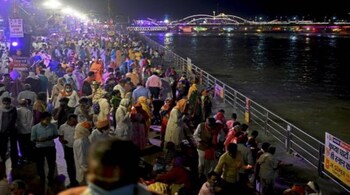
Uttarakhand Police has begun using Artificial Intelligence (AI) to catch those flouting COVID-19 norms during the ongoing Kumbh meal. The move is aimed at ensuring COVID-appropriate behaviour as massive crowds expected at Haridwar, despite the surge in cases.
The police said that over 350 CCTV camera have been set up in the area. Of which, 100 are equipped with sensors that generate an alert every time a person is seen without a facemask, the Indian Express reported.
This is the first time that such a technology is being used to monitor crowds at the largest religious gathering in the world.
Kumbh Mela 2021: Here's everything you need to know before visiting
The personnel deployed at the police surveillance control room shares the location of the violator to the nearest enforcement teams. The violator is then given a free mask and fined as per the rules.
"When a site identified as vulnerable gets crowded beyond 75 percent of its capacity, the control room gets an alert, at which point, entry of people to these sites will be immediately stopped," said Mukesh Thakur, Additional SP in charge of the Police Surveillance Control Room at Kumbh, as per the report.
Track this LIVE blog for latest updates on the coronavirus pandemic
Besides, the CCTVs also help in identifying objects lying unattended for over 10 minutes and to keep a count of vehicles at parking lots.
Massive crowds are expected to gather at Haridwar throughout April 2021 for the Kumbh Mela. This year the government expects over a million pilgrims a day to bathe in the sacred river. Over 5 million people are expected per day on the most auspicious days – April 12, 14 and 21 – for a total of 100 million celebrants.
The government has issued several directives to control the spread of the disease. Thermal screening checkpoints have been set up, and efforts are being made to sanitize all restrooms and sleeping quarters.
In pics | Rallies, religious gatherings aggravate India's worst COVID-19 surge
Strict protocols for participation in the Kumbh have been issued, including a limited time period of half an hour for each akhara to bathe.
Furthermore, the government has stated that after April 1 all visitors to the Kumbh have to produce evidence of a recent negative COVID-19 test.
However, even before the Kumbh began, the city and neighbouring areas had already emerged as COVID-19 hot spots.
The congregation on the banks of the Ganges in Haridwar in Uttarakhand will take place from April 1 to 30, with three "shahi snan" (major bathing) dates on April 12, 14 and 27.
Click here for Moneycontrol’s full coverage of the coronavirus pandemic
Discover the latest Business News, Sensex, and Nifty updates. Obtain Personal Finance insights, tax queries, and expert opinions on Moneycontrol or download the Moneycontrol App to stay updated!





