

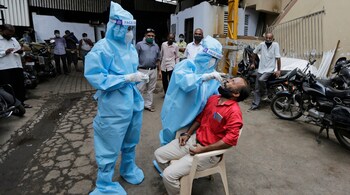
The first case of XE, a more transmissible variant of Covid-19, was reported in Mumbai on Wednesday, according to officials at the Brihanmumbai Municipal Corporation (BMC). A woman who arrived from South Africa in February was found to have this Omicron sub-variant, officials had claimed earlier, adding that she was asymptomatic and recovered from the infection.
The XE variant is a mutation of the BA.1 and BA.2 Omicron strains, referred to as a “recombinant". As per the initial studies, the XE variant has a growth rate of 9.8 percent over that of BA.2, also known as the stealth variant because of its ability to evade detection.
The South African national had arrived in the country on February 10 and was tested on February 27 for Covid-19 with her test returning a positive result. Her lab sample was referred to Kasturba Hospital Central laboratory for genome sequencing. It has been found to be a new XE variant in initial sequencing.
Though GISAID also confirmed it, INSACOG (Indian SARS-CoV-2 Genomics Consortium) has decided to go for another round of genomic sequencing at a national laboratory for sure confirmation of XE variant, official sources said.
CENTRE DENIES CLAIM
Hours after the report of detection of XE variant, the Ministry of Health said that the present evidence doesn’t suggest the presence of new variant. According to the central agencies, the diagnosis of the sample was wrong and a misclassification.
“FastQ files (raw genome data) in respect of the sample, which is being said to be XE variant, were analysed in detail by genomic experts of INSACOG who have inferred that the genomic constitution of this variant does not correlate with a genomic picture of XE variant. The present evidence does not suggest it as an XE variant,” official sources said in Delhi.
BENGALURU LABS DISAGREE WITH CENTRE’S DENIAL
Bengaluru-based labs, which are also part of INSACOG, expressed apprehension that the centre has branded the first XE variant as misclassification due to analysis error.
According to a report in Deccan Herald, a scientist from Bengaluru-based MedGenome Labs said that there have been enough reported cases of XE variant in the UK and the scientists are aware of its annotations. “I don’t think premier national labs will make sequencing or analysis errors. The variant’s genome data is constantly getting updated by institutes globally,” the scientist reportedly said.
He added that that if the new sub-variant was not updated in the international databases, then it could have been tricky to identify. However, the XE’s data is publicly available and if only a particular lab has not updated its pipeline, then only could they miss it.
Dr Raja Mugasimangalam, CEO and founder of Genotypic Technology, also added that he didn’t consider the detected of XE variant as a software glitch.
GUJARAT DETECTS FIRST CASE?
A case of XE variant of Covid-19 was detected in Gujarat, sources in health minister confirmed on Saturday.
“Samples from Gujarat have been sent to NCDC, but from what we see this fits the definition of XE more than the Mumbai one,” a highly placed official told The Hindu.
The report added that the Gujarat Biotechnology Research Centre, an NSACOG laboratory in Gujarat has reportedly confirmed the variant.
The XE variant was reported in a 60-year-old male from Gotri area of Vadodara city in a sample from March 11. The infected person has no history of inter-state travel.
The new infection in Gujarat could be considered as the first XE case in the country as the final report in the Maharashtra case is awaited.
BOOSTER EXTRA SHIELD
Union Health Minister Mansukh Mandaviya announced Centre’s decision to expand booster dose to all adults.
“Adding an extra layer of safety! Precaution Dose to be available to 18+ age group from 10th April, 2022, at Private Vaccination Centres. All 18+ who have completed 9 months after administration of 2nd dose, would be eligible for Precaution Dose,” Mandaviya said in a tweet.
The move to expand the coverage of booster dose is also seen as an extra step to ensure protection amid the XE variant. It is being considered that the third shot will reduce severe illness, hospitalisations, and death, even if they do not offer complete protection against the sub variant of Omicron.
Discover the latest Business News, Sensex, and Nifty updates. Obtain Personal Finance insights, tax queries, and expert opinions on Moneycontrol or download the Moneycontrol App to stay updated!





