

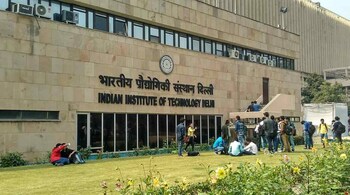
Early graduation, flexible grading system, option to appear for exams later and no termination are among the alternatives being offered by the Indian Institutes of Technology (IITs) for their graduating students to ensure their future plans are not affected due to the COVID-19 lockdown.
IIT-Delhi is giving two options to its graduating batch - those who have less than a semester left to graduate, can decide to either go for an "early graduation" option, happening in June-end, or go through a "regular graduation process", which will happen as and when the institute reopens.
"For the early graduation option too, we are offering two choices to students-- an 'audit pass or fail' option or a 'credit' option. While the former will allow students to use their previous grades for assessment, for the latter students will have to take online tests, home exams, assignments, telephone viva, among others," IIT Delhi Director V Ramgopal said.
IIT Roorkee has come up with a one-time special provision in which the performance of the students in spring semester 2019-2020 would not be counted for academic performance-based termination of programs, slow pace programs, and towards any other such clauses.
Coronavirus India News LIVE Updates
"We have introduced a system to convert a pass letter grade to a Satisfactory (S) grade without grade point if a student requests for the same. The weightage ranges of various evaluation components have been revised. Further, students also have the option to appear in a re-exam to improve their grades," institute Director AK Chaturvedi said.
"Online evaluation modes have been introduced for MTech and PhD Thesis and BTech Projects. Students who wish to do more work in their thesis are allowed to get their evaluations deferred. Similarly, for MTech and PhD Course work, the students who are not prepared and require more time may request for deferred evaluation, which will be conducted within the first 4 weeks of the next semester," he added.
IIT Guwahati is giving students an option to opt for I (Incomplete) grade if they are facing any difficulties and once the institute resumes academic activities they will be able to go for a reassessment.
"Students may opt for 'I' (Incomplete) grade if there are serious difficulties related to electricity, network or physical and mental issues. Once institute resumes academic activities, based on the convenience of the instructors, reassessment for 'I' grade will be completed. An 'Academic Grievances Cell' has been formed by the institute for handling all grievances of students related to examinations and other academic difficulties arising due to the COVID-19 pandemic," said Chitralekha Mahanta, Dean of Academic Affairs, IIT Guwahati.
IIT Gandhinagar has come up with a new grading policy for graduating students and has launched one-year post graduate diploma programme to help its graduating students whose higher education or employment plans have been disrupted due to the coronavirus outbreak.
"We will will not be issuing any letter grades for courses in the second semester. Two new grades are being introduced - P(E) and I/F' for all courses this semester. The Institute has requested faculty members to consider reworking their earlier grading or evaluation policies, if warranted," said Pratik Mutha, Dean (Academic Affairs), IIT Gandhinagar.
While P(E) grade or Pass (Emergency) is a pass grade but will have a different connotation than the usual 'P' Grade and will be so notated on the transcript. The 'I/F' grade denotes 'Incomplete/Fail' but will not distinguish between the two.
"P(E) grade will be awarded if the faculty assesses that a student had satisfied the requirements for passing the course. An I/F grade will be assigned if the student did not complete the requirements of the course or did not perform well enough to warrant a passing grade.
"All students given an I/F grade will have one opportunity to complete the course requirement and improve their performance and earn a P(E) grade. The deadline to do so will be communicated to students well in advance," Murtha added.
IIT Kharagpur has decided to evaluate students' performance on the basis of their grades in the mid-semester examination, assignments and viva voice in view of the students' inability to reach the campus to take the end semester examination because of the lockdown.
"We have arrived at the decision for this semester only as it is getting late and difficult to conduct the exam in June considering travel restrictions with most of the students staying at home," an institute's spokesperson said.
Universities and schools across the country have been closed since March 16 when the Centre announced a nationwide classroom shutdown as part of a slew of measures to contain the COVID-19 outbreak.
Later, the government announced a nationwide lockdown, which began on March 25.
The lockdown was initially imposed for a 21-day period till April 14. However, it was extended till May 31. The government had announced phase-wise easing of restrictions while the lockdown will continue in containment zones till June 30.
Follow our full coverage of the coronavirus pandemic here.
Discover the latest Business News, Sensex, and Nifty updates. Obtain Personal Finance insights, tax queries, and expert opinions on Moneycontrol or download the Moneycontrol App to stay updated!





