

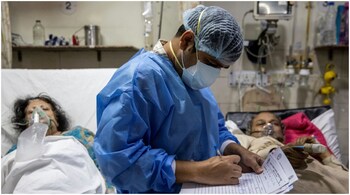
The World Health Organisation (WHO) on May 31 said that it will name coronavirus variants from different countries using Greek alphabets. Thus, two COVID-19 variants first detected in India has now been dubbed as 'Delta' and 'Kappa'.
Delta in particular, scientifically named B.1.617 or the "double mutant" variant is considered to be more infectious and thus likely responsible for the exponential surge in infections in India since mid-March. Kappa, scientifically known as the B.1.617.1 variant was found earlier in the country.
Follow our LIVE blog on the COVID-19 pandemic here
"The labels don’t replace existing scientific names, which convey important scientific information and will continue to be used in research. No country should be stigmatised for detecting and reporting COVID-19 variants," WHO official Dr Maria Van Kerkhove added.
The Government of India had, on May 12, marked its objection over the B.1.617 variant being referred to as "Indian variant of coronavirus" by sections of the media.
"Several media reports have covered the news of WHO classifying B.1.617 as a variant of global concern. Some of these reports have termed the B.1.617 variant of the coronavirus as an ‘Indian Variant’. These media reports are without any basis, and unfounded," the government said in a statement.
Also Read | No data to show double mutant variant is resistant to vaccination: WHO's Soumya Swaminathan
Taking cognisance of India's objection, the UN health agency had clarified that it does not label any coronavirus variant after the country where it was first detected.
"WHO does not identify viruses or variants with names of countries they are first reported from. We refer to them by their scientific names and request all to do the same for consistency," stated a tweet posted on the official handle of WHO South-East Asia.
Discover the latest Business News, Sensex, and Nifty updates. Obtain Personal Finance insights, tax queries, and expert opinions on Moneycontrol or download the Moneycontrol App to stay updated!





