

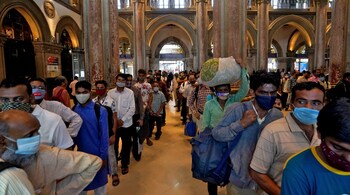
Amid resurgence of COVID-19 cases in many parts of India, the Centre on March 23 issued fresh guidelines for all states and Union Territories that will come into effect from April 1. The new guidelines will remain enforced for at least a month.
The Ministry of Home Affairs (MHA) asked states and UTs to focus on the "test-track-treat protocol" to avert a second wave of novel coronavirus infections.
New central guidelines
The central government urged that states where the proportion of RT-PCR tests is less should rapidly increase it, to reach the prescribed level of 70 percent or more.
The home ministry asked local administrations to demarcate containment zones where intensive house-to-house surveillance, contact tracing and surveillance for influenza like illnesses (ILI) and severe acute respiratory infections (SARI) can be carried out.
The Union home ministry has also asked the states and UTs to promote COVID-19 appropriate behaviour in work places and in public, especially in crowded places.
Follow our LIVE blog for the latest updates of the coronavirus pandemic
Strict enforcement of wearing face masks, hand hygiene and physical distancing will continue. States and UTs may also consider administrative actions, including imposition of fines, it said.
The Centre said that there won’t be any restrictions on inter-state and intra-state movement of persons and goods and allowed the continuance of permitted activities outside containment zones.
Various states have updated their COVID-19 regulations amid a spike in cases. These new restrictions have also been imposed keeping in mind Holi and other festivals. Here’s what some of these states have done:
Punjab
State-wide restrictions will be imposed starting from March 27 under which all educational institutions, except medical and nursing colleges, will remain closed till the end of the month.
The state government has said that not more than 10 visitors should be allowed inside a house.
The capacity of cinema halls will be capped at 50 percent. A fine of Rs 1,000 will be imposed on persons not wearing face masks.
Madhya Pradesh
A seven-day quarantine has been made mandatory for all travellers coming from Maharashtra. A night curfew has been imposed in Bhopal and Indore from 10.00 pm to 6.00 am.
Shops will close at 10.00 pm in Gwalior, Ratlam, Jabalpur, Ujjain, Burhanpur, Chhindwara, Khargone, and Betul.
Maharashtra
Witnessing a major spike in cases, all religious, social, cultural and political gatherings in Maharashtra have been banned.
Areas under the Nagpur Police Commissionerate will remain under a lockdown until at least March 1.
For entry, malls in Mumbai now require an RT-PCR negative report. The Brihanmumbai Municipal Corporation (BMC) on March 23 announced that Holi celebrations will not be permitted in both private and public places.
The circular, issued by BMC Commissioner Iqbal Singh Chahal, said that considering the surge in cases and in view to avoid any crowding in the city, 'Holi Dahan' or the burning of Holi fire on March 28 and 'Rangpanchmi' celebrations on March 29 will not be allowed.
A night curfew has been imposed in Pune, Aurangabad, Nanded, Osmanabad, Palghar, Nashik and Jalgaon.
Tamil Nadu
Travellers from Kerala and Maharashtra need to spend seven days in home quarantine and must monitor their health for another week.
Karnataka
From March 25, passengers coming from Punjab and Chandigarh must carry a negative RT-PCR test report not older than 72 hours while entering the state. This applies to those travelling by flight, bus, train and by road.
Earlier, the Karnataka government had said that those travelling from Kerala and Maharashtra would require a COVID-19 negative test result.
Delhi
The Delhi government has banned all gatherings on the occasions of Holi, Navaratri and Shab-e-Barat, according to an official order on March 23.
The Delhi Disaster Management Authority (DDMA) has warned of penal action against those found flouting the order barring congregations on the upcoming festive occasions.
Uttarakhand
Uttarakhand has made the RT-PCR test mandatory for those entering the state from Maharashtra, Gujarat, Chhattisgarh, Kerala and Madhya Pradesh.
In a lockdown of sorts – the Dehradun district magistrate has directed people living in Mussoorie's Galway Cottage and St. George’s School, Barlow Ganj areas to stay indoors till further order.
Gujarat
A night curfew has been imposed in Ahmedabad, Surat, Rajkot and Vadodara from 10 pm to 6 am.
All public places such as lakefronts, public gardens, parks and gardens will remain closed. Eateries in Ahmedabad will close at 10.00 pm.
Click here for Moneycontrol’s full coverage of the coronavirus pandemic
Discover the latest Business News, Sensex, and Nifty updates. Obtain Personal Finance insights, tax queries, and expert opinions on Moneycontrol or download the Moneycontrol App to stay updated!





