

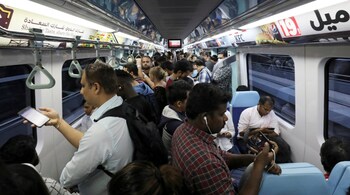
India’s empty streets are as much a testimonial to state enforcement as to voluntary social distancing. The country needs it desperately.
But social distancing breaks down at the market place, where daily rations need to be picked up because they cannot be stocked. In the mornings and evenings, it is a routine sight to see long queues of people waiting to buy their rations. In many cases, desperation overrides considerations of safety.
Yet again, poor or inadequate infrastructure is coming in the way. Going to the mom and pop stores becomes mandatory because the home delivery system has crashed.
It would be instructive to remember that despite the rapid growth of digital advertising industry, which stands at 33.5 percent, and the fact that there are 220 million Indians who access digital services through their smartphones, in absolute terms much less than half the country uses such methods for on line shopping. The vast majority in small towns and suburban India still prefer the colony store, which remains a far more personal proposition.
But even this delivery of essential items via e-commerce platforms continue to face challenges in the early days of the 21-day lockdown, which is nearly certain to be extended, with dire predictions of a long-haul anti-COVID-19 battle ahead.
The industry has urged the government for uniform classification of essential items across various states. While the government has allowed delivery of all essential goods including food, pharmaceuticals and medical equipment through e-commerce, online platforms like Amazon India, Grofers, BigBasket and Milkbasket are faced with disruptions in delivery.
Insiders say e-commerce companies are battling to procure passes for their logistics and delivery staff in various states. Since the logistics is time consuming and often clumsy while dealing with huge demand, there is urgent need for the government to look at alternate mechanisms like digital checks. The industry also wants uniform classification of essential items across the states, which needs to go down clearly to last mile delivery agents. There is no other way out.
Lack of preparedness
The sudden and substantial spike in demand for home delivery services have also taken the companies by surprise. Walmart-owned Flipkart told the media that they had “seen high demand on the platform, and (were) working towards making deliveries at the earliest in collaboration with our sellers,” and were “expecting that following government intervention, inter-state transport movement will also stabilize.”
The story of Grofers ran a similar course. This week, the company saw some of its delivery staff getting arrested and over 60,000 deliveries affected. Subsequently, they resumed operations in Delhi, Gurugram, Faridabad, Noida, Ghaziabad, Bengaluru, Ahmedabad, Lucknow and Kanpur after assurances from local authorities.
If such criticism had been merely limited to being an appraisal of e-commerce marketing, the damage would not be as far reaching. But, given the fact that such chaos at the local marketing centres delivers a body blow to the concept of social distancing, it becomes a cause for worry.
While the World Health Organization (WHO) has recommended social distancing as a preventive measure against the novel coronavirus, maintaining a distance of one metre from a coughing or sneezing person, the realities on ground are quite something else. India’s dense population and poverty is a serious challenge at hand.
Population tinderbox
India is not only the second most populated country after China, but also the second most densely populated. Her population density is next only to Bangladesh’s. About 455 people live within a sq. km. area in India compared to 1,240 in Bangladesh on an average, according to data from the World Bank. China, where the COVID-19 outbreak originated, has a population density of only 148.
Sure, this density is by no means uniform. According to the 2011 Census, India’s population density stood at 382. While major states such as Delhi, Bihar, West Bengal, Kerala and Uttar Pradesh were regarded as double that number, Himalayan and mountainous regions like Uttarakhand, Himachal Pradesh, and the northeastern states — save Tripura and Assam — had less than half that density.
In high density areas, maintaining a public distance of one metre might be a tall order. For example, the Gandhi Nagar sub-district of Delhi — the most densely populated area in 2011 — had a population mass of 89,185 persons per sq. km. In other words, even if Gandhi Nagar was a flat ground with no personal belongings, a person would have only a square of 3.4 metres available to him or her!
Add to this the country’s dilapidated health infrastructure. Ramanan Laxminarayan, economist and an epidemiologist, who is director of the Center for Disease Dynamics, Economics & Policy in Washington and a senior research scholar at Princeton, wrote in The New York Times that “India’s high rates of tuberculosis, pneumonia, smoking and poor air quality won’t help when it comes to a respiratory disease.”
“Some were counting on the summer heat and humidity to bail India out, but there was no evidence that the rising temperature would stop the disease,” he wrote this week, rather ominously.
If Laxminarayan’s estimates prove to be true, then 300 million to 500 million Indians were likely to be infected with the coronavirus by the end of July. Of them, about a tenth — 30 million to 50 million — would most likely be severe.
India has less than 1 lakh intensive-care unit beds and 20,000 ventilators, most of which are only in the large cities. The scenes where Italian doctors had to choose between multiple patients to determine who would get a ventilator would increase multifold in India’s weak health system, adding to the country’s mounting infrastructural woes.
Ranjit Bhushan is an independent journalist and former Nehru Fellow at Jamia Millia University. In a career spanning more than three decades, he has worked with Outlook, The Times of India, The Indian Express, the Press Trust of India, Associated Press, Financial Chronicle, and DNA.
Discover the latest Business News, Sensex, and Nifty updates. Obtain Personal Finance insights, tax queries, and expert opinions on Moneycontrol or download the Moneycontrol App to stay updated!





