

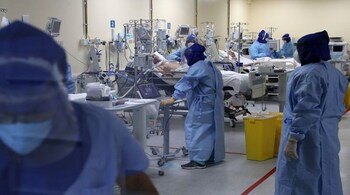
With the number of new coronavirus positive cases being reported daily declining over the past 10 days in Delhi, more than 10,000 dedicated COVID-19 beds are lying vacant.
As per the Delhi Corona app, as many as 10,028 beds earmarked for treating COVID-19 patients are lying vacant as of October 5. Only 36.6 percent of total coronavirus beds are currently occupied. For live updates on coronavirus, click here
However, the occupancy rate is far higher for intensive care unit (ICU) beds. Of the total 2,914 ICU beds – including those without ventilators – reserved for COVID-19 patients, 63.7 percent are currently occupied.
Of the total number of ICU beds in Delhi, hardly 40 percent or 1,184 are in government hospitals, and the rest are all in private hospitals. Data reflected on the Delhi Corona app reveals that the occupancy rate is relatively higher at private hospital ICU beds at 70.3 percent as against 53.8 percent at government hospitals.
Notably, when Delhi was experiencing a steep rise in coronavirus infection in September, the Aam Aadmi Party government had told all hospitals to increase the number of ICU beds. Arvind Kejriwal’s government had also told 33 private hospitals to keep 80 percent of their ICU beds exclusively for coronavirus patients.
Meanwhile, the number of hospitalisations in the national capital has reduced from over 7,000 during September third week to 5,896 on October 4. Delhi has registered over 2,91,000 coronavirus cases so far, of which more than 2,60,000 have recovered and 5,510 COVID-19 positive patients have died.
Follow our coverage of the coronavirus crisis here
Discover the latest Business News, Sensex, and Nifty updates. Obtain Personal Finance insights, tax queries, and expert opinions on Moneycontrol or download the Moneycontrol App to stay updated!





