

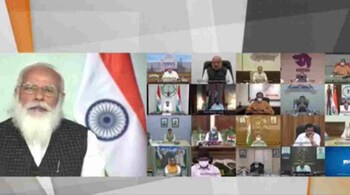
In an interaction with Prime Minister Narendra Modi to discuss the COVID-19 situation and the ongoing vaccination drive, the chief ministers sought attention towards shortage of coronavirus vaccines and demanded permission to vaccinate younger people.
Currently, the inoculations are limited to those aged over 45 year in the country.
During the meeting, the CMs gave feedback about the COVID-19 situation in their respective states, said a statement issued by the prime minister’s office. They said that the timely initiation of vaccination drive is resulting in saving lakhs of lives. Issues of vaccine hesitancy and vaccine wastage were also discussed, said the statement.
Talking to PM Modi, Odisha Chief Minister Naveen Patnaik drew his attention to the shortage of the COVID-19 vaccine in the state. Noting that half of Odisha’s vaccination centres having halted activities for want of Covishield, he requested the prime minister to ensure that the state gets to stock up doses 10 days in advance for the vaccination drive to run smoothly.
Patnaik asserted that Odisha has taken measures to make sure that vaccine wastage is low, and put in place an "efficient mechanism" to administer shots to all eligible persons. The state has "reactivated" its system to tackle the rise in the COVID-19 cases, he said.
The chief minister also sought Rs 300 crore from the Centre for managing the COVID-19 situation.
Follow our LIVE blog for the latest updates of the novel coronavirus pandemic
Maharashtra CM Uddhav Thackeray told the prime minister that the state was not lagging behind in the fight against COVID-19, and urged him to affirm there should be no politics in this effort. Maharashtra is one of the states that have shown a steep rise in the daily COVID-19 cases.
Thackeray requested the prime minister to address the leaders of all political parties, asking them to refrain from indulging in politics on the issue. Some senior functionaries of the Maharashtra government had recently hit out at the Centre over the alleged low availability of vaccines in their state.
Delhi Health Minister Satyendar Jain also said that the fight against coronavirus was not a Centre-versus-state issue and should not be politicised.
During the meeting, Punjab Chief Minister Amarinder Singh apprised the prime minister of the situation in the state and the steps taken by his government to control and manage the disease. Immediately after the meeting, Singh wrote a letter to PM Modi, in which he urged the Centre to give flexibility to states to devise local strategies for COVID-19 vaccination within the broad parameters of the central government's approach. He also sought a review of norms in order to allow all adults in high-risk areas to be immunized, along with people below the age of 45 suffering from liver and kidney diseases.
Also read | Over 36 lakh people get COVID-19 vaccine in India on April 8, 9.43 crore shots administered so far
Chhattisgarh Chief Minister Bhupesh Baghel requested the prime minister to allow all people above 18 years to get vaccinated against COVID-19.
Meanwhile, the Andhra Pradesh government is sending an SOS to the Centre seeking immediate supply of at least one crore doses of the coronavirus vaccine as the current stock available in the state would last no more than two days. The state currently has just three lakh doses of the vaccine while on an average 1.4 lakh people were being inoculated per day, health department officials told Chief Minister YS Jagan Mohan Reddy during a review meeting in Amaravati on the day.
Interacting with CMs, PM Modi urged them to strengthen efforts for the next 2-3 weeks to check the spread of the virus on a "war-footing". He also lamented that administration was appearing lax in many states. Modi asked the chief ministers to focus on micro-containment zones and reiterated his call to work on the mantra of test, track, treat besides pushing COVID-appropriate behaviour and COVID-management to bring down the peak. He asked states to not bother much about positive cases and focus on more testing.
(With inputs from PTI)
Follow our full coverage on COVID-19 here.
Discover the latest Business News, Sensex, and Nifty updates. Obtain Personal Finance insights, tax queries, and expert opinions on Moneycontrol or download the Moneycontrol App to stay updated!





