

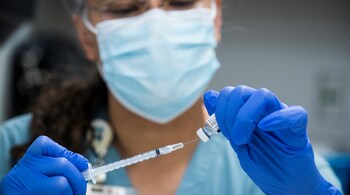
India had launched its COVID-19 vaccination drive on January 16. In the initial phase, three crore healthcare and frontline workers across the country are being inoculated.
India deployed two COVID-19 vaccines for the rollout; one is Serum Institute of India’s (SII) Covishield and the other is Bharat Biotech's, Covaxin. While Covishield was given restricted emergency use approval (EUA) by the government, Covaxin was allowed EUA on clinical trial mode, as the vaccine hasn't yet submitted the Phase-3 efficacy data. Both the vaccines have to be given in two doses.
India reported 10.8 million Covid-19 cases, with a recovery rate of around 97 percent, which is one of the highest in the world.
Here is an explainer on where India stands in terms of vaccination numbers; details about the second dose; has India overcome vaccine hesitancy and what are the challenges in the way of increasing vaccination speed?
How many people have been vaccinated so far?
India has vaccinated 8.3 million healthcare and frontline workers, as on February 15. About three-fourths of those injected include healthcare workers, while the rest are frontline workers. The nationwide coverage of COVID-19 vaccination for healthcare workers was 60 percent. The vaccination of frontline workers, which began on February 1, was able to cover 11 percent of the targeted two crore. The government has said it will inoculate about one crore healthcare workers in the first phase. This will be followed by jabbing two crore frontline workers, including police, the armed forces, municipal workers and revenue staff.
Which states and Union Territories are ahead in vaccination coverage and who are the laggards in the first phase? Bihar achieved the highest COVID-19 vaccine coverage of healthcare workers at 80.6 percent, followed by Tripura (78.9 percent), Odisha (76.7 percent), Madhya Pradesh (75.8 percent), Uttarakhand (74.8 percent), Himachal Pradesh (74.5 percent), Chhattisgarh (73 percent), Kerala (71.1 percent) and Rajasthan (70.7 percent). Among the Union Territories - Lakshadweep has the highest coverage of 81 percent. The states that are lagging behind include Meghalaya (37.2 percent), Manipur (37 percent), Punjab (36.4 percent), Tamil Nadu (33.9 percent) and Nagaland (23 percent). The Union Territories with the lowest coverage are Chandigarh (32.1 percent) and Puducherry (19.9 percent).
When will the second dose of inoculation begin?
The second dose of vaccination for beneficiaries, who have completed 28 days after receipt of the first shot, began on February 13. The approval provided by the Drug Controller General of India (DCGI), accords a window of four to six weeks for the second dose. So far 24,561 healthcare workers have received the second jab. Vaccination is said to be complete only if the beneficiary has received two doses. Antibodies against vaccines will develop about 14 days after the second shot.
When will vaccination begin for those over 50 years and persons with co-morbidity?
The third phase, in which the government plans to inoculate 27 crore people above 50 years of age and those with co-morbidity like diabetes, hypertension, and organ transplant patients, will begin in March 2021.
What about the CoWIN glitches?
CoWIN - the digital backbone of the COVID-19 vaccination in India - has largely stabilized. The platform was plagued with technical glitches during the initial days of vaccination, delaying the rollout in several places. While most problems have been sorted out, complaints like duplication of names, beneficiaries not receiving SMS, and details of their vaccination slots, continue. With vaccination for the 50-plus set to begin, the platform will come under increasing scrutiny.
Is vaccine hesitancy on the wane?
Vaccine hesitancy among healthcare workers is the possible reason behind the low coverage of COVID-19 vaccination in many states. Fears of vaccine-induced side effects, the waning pandemic and the 'wait and watch' approach for more COVID-19 vaccine options, has kept many healthcare workers away from getting inoculated. In many hospitals, the heads of departments are leading the way by taking the vaccine. Some hospitals have also organised counselling sessions with senior doctors, putting up 'selfie-points' where those who get vaccinated can take photos and upload them on social media. All these are done with an eye on nudging hesitant healthcare workers to bite the bullet.
What about serious adverse reactions during the last month?
Government figures say that a mere 0.0004 percent were hospitalised against vaccinations, which is negligible. As of February 13, there were 34 hospitalisations, of which 21 were discharged, two were under treatment and 11 passed away.
Which vaccines are deployed the most?
The Covishield vaccine is being used widely. The government through HLL Lifecare Limited bought 11 million doses of Covishield from Serum Institute at Rs 200 per dose, 3.85 million doses at Rs 295 per dose and 1.65 million doses at no cost of Covaxin from Bharat Biotech. The government purchased an additional 1 crore doses from SII at Rs 210 per dose. It is committed to buy 4.5 crore doses in the initial phase.
Is there a need for increasing the speed of vaccination? Yes. On an average, India is inoculating about three lakh people per day, which is way short of the government's target of 13 lakh people a day! At the current pace, it will take two-and-a-half years to inoculate the entire population with two doses of the vaccine. The government needs to step up speed to ensure that at least the most vulnerable segment of the population is vaccinated as fast as possible, in the backdrop of the virus mutating and threatening to reduce the impact of the existing vaccines.
Discover the latest Business News, Sensex, and Nifty updates. Obtain Personal Finance insights, tax queries, and expert opinions on Moneycontrol or download the Moneycontrol App to stay updated!





