

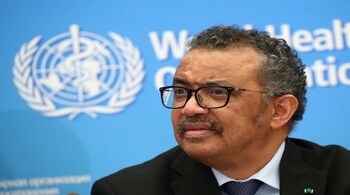
World Health Organisation (WHO) Director General Tedros Adhanom Ghebreyesus has lauded India’s Aarogya Setu app, saying that it has helped public health departments identify COVID-19 clusters and expand testing.
"Aarogya Setu app from India has been downloaded by 150 million users, and has helped city public health departments to identify areas where clusters could be anticipated and expand testing in a targeted way," the WHO chief said at a media briefing.
As reported by the Indian Express, Ghebreyesus also mentioned the contract tracing applications used in Germany (Corona Warn app) and the United Kingdom (the National Health Services' COVID-19 app), among others, that helped healthcare systems in tracing probable infected persons.
India's COVID-19 tracing app was launched by PM Modi on April 3. It was developed by the National Informatics Centre (NIC) under the Ministry of Electronics and Information Technology (MeitY).
The main aim of the app was to help users in identifying whether they are at risk of being infected by the coronavirus by checking if they have knowingly or unknowingly come into contact with individuals that have tested positive for COVID-19.
The app received mixed reviews, with some privacy concerns arising soon after launch. The app is mandatory to use for air travel, train travel, workplaces and for most central government employees in India
Follow our LIVE blog for the latest updates of the novel coronavirus pandemic
This is not the first time India has been lauded by the WHO. Ghebreyesus had praised India’s efforts in containing the spread of coronavirus in Mumbai’s Dharavi slum, saying that despite the situation being intense, it was brought under control.
WHO on April 14 had also lauded "India's tough and timely actions" against the the spread of the novel coronavirus.
Follow our full coverage of the coronavirus pandemic here.
Discover the latest Business News, Sensex, and Nifty updates. Obtain Personal Finance insights, tax queries, and expert opinions on Moneycontrol or download the Moneycontrol App to stay updated!





