

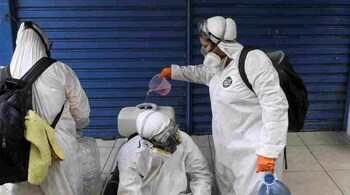
The exponential rise in COVID-19 cases, and the detection of a double mutant of Coronavirus -- E484Q and L452R -- in 15-20 percent of the positive samples sequenced from Maharashtra, are raising concerns.
The double mutation was detected by the Indian SARS-CoV-2 Consortium on Genomics (INSACOG).
Maharashtra alone had 35,952 new COVID-19 cases, representing about 61 percent of all positive cases in the country, as on March 26. India has reported 59,118 cases on the same day.
Moneycontrol spoke to three leading experts who advise that vaccination, maintenance of physical distance and hand hygiene will help contain the second wave.
Rakesh Mishra, Director, Centre for Cellular and Molecular Biology (CCMB)
“The double mutation variant circulating in Maharashtra is still a minority variant affecting about 15-20 percent. People shouldn’t be too concerned about it,” he says.
At the moment, there is nothing to worry, as far as these variants are concerned, since there aren’t many re-infections and vaccines are still effective against them.
Mishra, who is also part of the Council of Scientific & Industrial Research (CSIR), is an expert at genomics and epigenetics. CCMB is part of INSACOG, which is sequencing positive samples collected from inbound travellers from foreign countries, and 5 percent of the latest positive samples. The genomic sequencing is done to find out the reasons for the rising COVID-19 cases.
Mishra warns that, in future, if any variant causes more re-infections, they may have to go to the drawing board to rework on the vaccines.
“Mutations are expected from RNA viruses. Mutations are marginally at a lower rate compared to some other RNA viruses. The nature of mutations will also depend on the people, their genetic make-up and ancestory,” he says.
"Testing, tracing, isolating and treating people are all in the government domain, but the public has to take precautions like wearing masks, maintenance of physical distance and hand hygiene and vaccination. All this will cut the transmission rate and leave less scope for the virus to mutate," Mishra adds.
The government has been aggressive at the genome sequencing of positive samples.
“We are sequencing a large number of samples. This will help us detect emerging variants. We are also analysing whether these variants have higher transmissability or can escape the immune system," Mishra said.
Dr Farah Ingale, Director, Internal Medicine, Hiranandani Hospital, Vashi-A Fortis Network Hospital
Ingale, who is treating COVID-19 patients, says mutations are common in viruses but most of them are insignificant and do not cause any change in its ability to transmit or cause serious harm.
Ingale, however, warns that certain mutations, like the ones in the UK or South African variants, can make the virus more infectious, and, in some cases, even deadlier.
“Having said that, in India, even with the increase in COVID-19 cases, the death rate remains low, as today, India is better prepared to handle the situation. There are protocols in place, there is early diagnosis and timely treatment is administered,” he says.
As per the INSACOG finding, such mutations confer immune escape and increased infectivity. At present, these have been categorised as Variants of Concern (VOCs) but require the same epidemiological and public health response of increased testing, comprehensive tracking of close contacts, prompt isolation of positive cases and contacts as well as treatment as per National Treatment Protocol defined by the ICMR.
Ingale says the difference between the symptoms of this new virus strain as compared to the original SARS-CoV-2 mutation (A2a haplotype (20A/B/C) with D614G,) has been very little .
The heightened symptoms of this new mutation include severe weakness and respiratory problems, persistent fever, higher infection among children, with mild and asymptomatic symptoms.
Dr V Ravi, retired professor of neurobiology at NIMHANS and nodal officer for Genomic Confirmation of SARS-CoV-2, Karnataka
“We need more studies to assess the impact of this variant on transmission,” he says.
“First, we need to isolate the mutant virus. The National Institute of Virology (NIV) should be on it. Then, we need to show it on cell culture that it is more infectious. Second, we need to trace all people who are positive for this mutant to see if the spread is more. Unless we do this, we will not be able to tell whether this is a VoC or not,” Dr Ravi says.
Mutations are taking place in the region called receptor binding domain (RBD).
“The spike protein is the most important protein. It is responsible for the attachment of the virus to the cell. Within the spike protein, there is one stretch which actually engages with the attachment. Depending on the type of mutation in that region, which we call as RBD, the virus sometimes gets an advantage. It improves the fitness of the virus spike protein to the cell, allowing the virus to get in more easily into the cells and multiply faster,” he says
Discover the latest Business News, Sensex, and Nifty updates. Obtain Personal Finance insights, tax queries, and expert opinions on Moneycontrol or download the Moneycontrol App to stay updated!





