

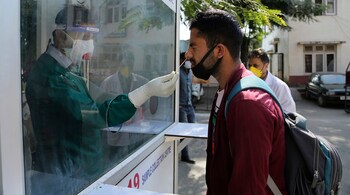
The Union health ministry on March 24 flagged the presence of a 'double mutant variant' and a number of 'variants of concern (VOCs)' in 18 Indian states. The mutated strains of COVID-19 have been identified amid a recent surge in infections across the nation.
The government, however, said the mutated variants "have not been detected in numbers sufficient to either establish or direct relationship or explain the rapid increase in cases in some states".
Genomic sequencing and epidemiological studies are continuing to further analyse the situation, the government said.
In other parts of the world which witnessed a second wave of the pandemic, the evolved strain of coronavirus was attributed as the primary reason for the resurgence of health crisis.
The havoc caused due to the mutated strain was witnessed in the United Kingdom, Brazil and South Africa - with variants found in these nations later spreading to other parts North and South Americas and Europe.
All major COVID-19 mutated strains identified so far
- UK variant
This strain of SARS-CoV-2 virus was detected first in the United Kingdom. It is scientifically called VUI 202012/01 or the virus of B.1.1.7 lineage. The mutated variant was found alarming after 62 percent of new cases detected in London, during the second week of December, was linked to this new strain.
More than 80 percent of Punjab’s new COVID-19 samples show the presence of a UK variant, which had compelled Chief Minister Captain Amarinder Singh to urge the Centre to relax the eligibility criteria for vaccination.
Also read: Explainer | Here’s everything you need to know about the UK strain and why is a cause for concern
- South African variant
Scientifically referred to as the virus of B.1.351 lineage, the South African variant has been attributed to a spike in cases in South Africa, the UK and parts of Europe.
In India, out of 1,0787 positive samples shared by states and union territories with the Indian SARS-CoV-2 Consortium on Genomics (INSACOG) since December, a total of 34 samples were detected with the South African variant, the Union health ministry said n March 24.
- Brazilian variant
The P.1 variant, also known as the Brazilian variant, was first detected in January when Japan screened passengers arriving from Brazil. It is tagged as a "variant of concern" by the American health watchdog as evidence suggests that is more transmissible than the normal strain of coronavirus. The P.1 variant can also reinfect people who had already been infected earlier by COVID-19, according to the US Centre for Disease Control and Prevention (CDC).
In India, out of the over 10,000 samples analysed by the INSACOG, only one was detected with the Brazilian variant so far, the government said.
N440K detected in Kerala
From Kerala 2032 samples (from all 14 districts) have been sequenced. The N440K variant that is associated with immune escape has been found in 123 samples from 11 districts, the Union health ministry said.
"This variant was earlier found in 33 percent of samples from Andhra Pradesh, and in 53 of 104 samples from Telangana. This variant has also been reported from 16 other countries including UK, Denmark, Singapore, Japan and Australia. As of now these can be at best said to be variant under investigation," it added.
E484Q and L452R mutations found in Maharashtra
The analysis of samples from Maharashtra has revealed that compared to December 2020, there has been an increase in the fraction of samples with the E484Q and L452R mutations, the health ministry claimed.
"Such mutations confer immune escape and increased infectivity. These mutations have been found in about 15-20 percent of samples and do not match any previously catalogued VOCs," it added.
These have been categorized as VOCs but require the same epidemiological and public health response of “increased testing, comprehensive tracking of close contacts, prompt isolation of positive cases and contacts as well as treatment as per National Treatment Protocol” by the states and UTs, the ministry further stated.
Discover the latest Business News, Sensex, and Nifty updates. Obtain Personal Finance insights, tax queries, and expert opinions on Moneycontrol or download the Moneycontrol App to stay updated!





