

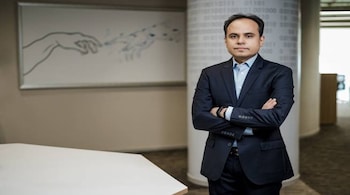
Srikanth Velamakanni, Co-Founder – Fractal Analytics, talks to Moneycontrol about why their revenue from India is almost zero, when they want to go public, and how they sift through half a million resumes a year when they hire talent. Fractal is a term from chaos theory that involves a lot of self-repeating patterns which when looked at from different scales all look similar.
“When targeting clients, we go by the 10-20-30 rule which is either $10 billion in revenue, $20 billion in market cap or clients having 30 million consumers, and there’s not many of those in India,” Velakamanni said.
Edited excerpts of the interview:
Tell us what your company does and specifically how you add value to businesses?
What we do is we bring in data algorithms so that executives can try their decisions, which include how to make better customer recommendations, or better personalisation or customer experience or how to improve operational effectiveness like increasing forecasting accuracy, or decreasing and managing risks. By the way, the first thing we ever did was to build risk models. We used to predict which loans would go bad. And therefore, how to build a portfolio so you never have the NPA problem. We actually served HDFC Bank, which was one of our first clients in India. We built the entire risk set-up models for HDFC Bank. And that is, I would say, a small part of why they became so successful, especially in the 2007-2008 period when the whole world was collapsing. Banks all over the world had 10 percent default rates, but these guys were at single-digit default rates because of the risk models that underlined these models we had built. And the basic decision that HDFC Bank made was around internal procedures.
While being a new-age company yours is not really a start-up, given you were launched in 2000. But you’re still privately held. Give us a bird’s eye view of your financing structure and how much fund-raising has happened thus far?
We have raised $680 million so far, of which $360 we raised from TPG. So, they own about a fifth, and about one fifth is owned by Apax Partners, who came in during 2018. One fifth is owned by myself and co-founder Pranay Agarwal, a fifth by Gulu Mirchandani and a fifth by Fractal employees. We want Fractal to be around 100 years from now. That’s just super important. How do you create, and build an institution that will be there when all of us are gone, is the mindset. To that extent going public is consistent with the plan. The private equity players have always come in with a certain horizon, five years or seven years. Even the ones who are long-term oriented will have, maybe, a seven-year horizon. But when you go public you are accountable for quarterly results and all that but the capital is permanent.
You have started using the.ai on your URL and the company name now, and reflects the artificial intelligence tag which is different from data analytics…
Actually, it’s difficult to differentiate between the two because the broadest definition of AI is to match or exceed human effort or intelligence. That’s really the idea. So, let’s take a very specific example. Do human beings make good decisions on loans? Not really, because we get influenced by things like if I wear a fancy suit and pull up in a fancy car. And you know, talk in a certain way, a loan officer gets impressed so they make decisions which are not objective. If they are in a bad mood, got up on the wrong side of the bed or fought with their spouse in the morning or something else, they would make a different decision. Same decision, same data, it may come up with different decisions every time. So, can an algorithm do a better job? Yes, absolutely yes. Specifically, if it can augment a human being, it’s even better. If we can, sort, of use a human-plus- machine makes a better job, right? So, this is AI, the sense that it is an algorithm that automatically makes decisions. You can also call it analytics. In my book, there is no difference between the two.
Are you profitable?
Last fiscal, we did Rs 1,295 crore of revenue with very good gross margins. We spent 10-15 percent of our revenue on R&D expenses. This is a very interesting tech area where things are changing very fast. We don’t disclose operating margins but they are really good. Our gross margins would be in the high 40s. And we’re also growing very rapidly. If you look at our March run rate, we were already at a Rs 2,000-crore run rate. It’s doing well because partly, obviously, we are executing well, but I think, the bigger industry reason here is that pre-2010 AI was just in its infancy. Around 2010 is when you started seeing all the major advances in AI coming to the limelight. Then from 2010 to 2015 was where I feel all the big companies, i.e., Facebook, Amazon, Netflix, and Google started investing significantly in AI. By 2015, what we saw was the entire bunch of Fortune 500 companies starting to understanding this area. Then in 2020 when Covid hit, it really took off quite significantly because now people around the world feel that companies have the feeling that they have to invest in AI, analytics, and so on. So, we’ve seen these three waves, so to speak. And Fractal’s growth has mirrored those waves.
So, given you have been profitable for three years running and have your management in place, when do you plan to go public?
We have been profitable, so there’s no challenge for us in being public. And frankly, we could have gone public earlier, in the sense that scale-wise there are many companies which are much smaller than us and which are public. Now or the near future is probably a good time, this is certainly on the roadmap for us.
What is your core challenge today?
Our biggest challenge is getting the right talent because the space is getting very big, very fast. Universities do not graduate enough qualified talent. So, some very interesting statistics I should share. In the last 12 months, we looked at 450,000 resumes. Out of those (nearly) half a million resumes we hired two thousand people. So, one in two hundred people we hire. To some extent it shows that we are very selective in who we hire, but it also shows you the quality of talent in India, which means that that’s the place where we need to invest a lot in creating that talent, building that talent and bringing it to market.
On a lighter note, are you using your own AI algorithms and data analytics to sieve out the best from a pool of resumes?
Yes, absolutely. I mean, at this point to sift through 450,000 resumes – it’s hugely impossible without some algorithmic help.
Indian companies are starting to see the value of data analytics but it is still quite slow....
Well, 99.5 percent of our revenues come from the overseas markets. It’s almost zero from Fractal India. Our strategic focus is this: 10-20-30, which is basically either $10 billion in revenue, $20 billion in market cap, or clients having 30 million consumers. So, we have defined this as the kind of company that we want to serve. They fit the 10-20-30 definition. There are very few companies that will fit that on the Indian landscape. And so, we have kept the entire focus on companies that are outside India because these are big companies, and we can do millions of dollars of revenue annually with them. Our goal is to do $20-$30 million worth business with each client everywhere.
Discover the latest Business News, Sensex, and Nifty updates. Obtain Personal Finance insights, tax queries, and expert opinions on Moneycontrol or download the Moneycontrol App to stay updated!





