

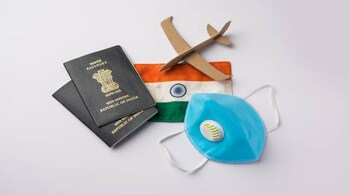
The decision of the European Medicines Agency (EMA), the bloc’s top medical authority, to exclude India-made Covishield and those vaccinated by it from its ‘green pass” has generated a lot of heat in recent days.
So, what is this green pass? Why has the EMA not recognised AstraZeneca’s India-manufactured Covishield but given the nod to its European counterpart Vaxzervria?
What is EMA?
The EMA is a decentralised agency of the EU, which is responsible for the scientific evaluation, supervision and safety monitoring of medicines in the bloc, says its website.
It is governed by an independent management board that has 36 appointed members not affiliated with any government, sector or organisation. It is largely a networking organisation whose activities involve thousands of experts from across Europe, with the mission to benefit the public and animal health.
Follow our LIVE blog on the COVID-19 pandemic here
What is the green pass?
Touted early as an “EU digital COVID certificate”, the travel pass, vaccine passport or “green pass”, as it has come to be known, serves to demonstrate whether its bearer has been vaccinated against COVID-19. It will also provide data about whether the person had COVID, has recovered or was recently tested.
From July 1, the green pass is being implemented by all 27 member states of the EU and their neighbours Iceland, Liechtenstein and Norway. The EU legislation governing the certificate will initially last a year.
The rules for testing and quarantining have not yet been made uniform by all EU states, with some requiring a PCR or lateral flow COVID-19 test between 24 to 72 hours prior to arrival, AFP reported. At present, EU does not accept antibody tests but this decision will be up for review in four months.
EU Justice Commissioner Didier Reynders said all member states were expected to be ready to implement the green pass on July 1, except Ireland, which was hit by a cyber-attack targeting its health service in May.
How does this pass work?
The green pass is a digital pass with a QR code that can be saved on one’s smartphone or tablet or printed on paper for scanning by authorities. AFP reported that the design provides each user with a unique digital signature, which connects to their COVID-19 data.
On privacy concerns, EU member states have said they will only collect data which is "strictly necessary" to oversee safe travel and this data will not be transmitted between countries or retained once verified.
As per EMA’s new guidelines, those in possession of green pass and belonging to EU will not have to quarantine once they arrive at their destination. Members wishing to impose quarantines will have to inform fellow member-states at least 48 hours in advance.
Which vaccines are allowed?
The EMA has allowed travel into the bloc for those who have received a complete dosage of any of these vaccines – Comirnaty (Pfizer-BioNTech), Janssen (Johnson & Johnson), Moderna and Vaxzervria (AstraZeneca).
Member states can on their own decide to approve and allow other vaccines which have been approved for emergency use (EUA) within their country or those approved by the World Health Organization, like China’s Sinopharm. Hungary is using Russia’s Sputnik V.
Also Read: Explainer | Mutated coronavirus, Alpha & Beta: Why are these variants of concern?
Why is India excluded?
India is excluded because EMA has counterintuitively accepted only one brand of the AstraZeneca jab– Vaxzervria.
The Serum Institute of India (SII) is producing the same vaccine under the ‘Covishield’ brand. It is also exporting it under the WHO’s COVAX programme to various African, South Asian countries and Canada among others.
How has India responded?
The government
India’s external affairs minister S Jaishankar has taken up the issue with Josep Borrell Fontelles, the EU’s High Representative, and promised to follow up the matter, PTI reported. The two met on the sidelines of the G20 foreign ministers' meeting and are said to have had a “comprehensive review of India's relationship with the EU”.
"Discussed vaccine production and access. Took up Covishield' authorisation for travel to Europe. Will be following up," Jaishankar tweeted.
The government has also lobbied for homegrown Bharat Biotech’s Covaxin to be added to the green pass, sources told the agency.
It has assured EU member states that it will adopt “policy of reciprocity” under which EU nationals, holding a Green Pass and travelling to India will also be exempt from quarantine period.
India has requested EU members to accept the vaccination certificate issued through the CoWIN portal, sources said.
SII
SII CEO Adar Poonawalla took to Twitter to assure that he was taking up the issue with the EU. Speaking to CNBC-TV18, Poonawalla said SII had applied to the EMA for approval of Covishield in the European markets and was also taking up the issue diplomatically.
"I realise that a lot of Indians who have taken Covishield are facing issues with travel to the EU, I assure everyone, I have taken this up at the highest levels and hope to resolve this matter soon, both with regulators and at a diplomatic level with countries," (sic) he tweeted on June 28.
“Covishield is already cleared by WHO and the United Kingdom's Medicines and Healthcare products Regulatory Agency (UKMHRA), so I hope the EMA clearance will also come on over the next few weeks,” he told CNBC-TV18.
Why is EMA’s decision controversial?
Most Indians have received Covishield. Low and middle-income countries dependent on India and the WHO’s COVAX initiative, too, have got Covishield jabs.
Has anything changed?
As of July 1, at least seven European countries in their individual capacities approved the Covishield COVID-19 vaccine for green pass'. These are Austria, Germany, Greece, Iceland, Ireland, Slovenia, Spain and Switzerland.
The development comes a day after India asked the members of the 27-nation grouping to individually consider allowing Indians who have taken Covishield and Covaxin vaccines.
So, can you travel to Europe?
Member-states are already accepting visitors from no-EU countries such as Switzerland, the United Kingdom and the United States of America.
Seven EU countries and Switzerland have allowed Covishield. The UK also recognises the vaccine as does Canada.
Concerns around delta variant
While the green pass is poised to boost Europe's busy summer vacation period, the more infectious delta variant is already looming – threatening to curtail its use and trigger an "emergency brake".
Member states are already on alert about fellow member states such as Portugal, which has reported a growing number of delta COVID-19 cases, and non-EU countries like Britain, which now has a rolling two-week infection rate more than seven times that of the EU.
Capital Economics noted: "There is no doubt that the tourist industry could do with a boost in time for the summer season. But, the EU certificate will have very little impact on European tourism this year. Most adults are not fully vaccinated and the delta variant is making people and governments more cautious".
Variants of concern
As per the latest figures, cases of the alpha variant have been reported in 172 countries, territories or areas, beta in 120 countries (one new country), gamma in 72 countries (one new country) and delta in 96 countries (11 new countries).
The WHO has said the delta variant is now present in nearly 100 countries as per conservative estimates and warned that in the coming months given the increase in transmissibility, the variant is "expected to rapidly outcompete other variants and become the dominant variant over the coming months".
For full coverage on the coronavirus pandemic click here
(With inputs from PTI, AFP)
Discover the latest Business News, Sensex, and Nifty updates. Obtain Personal Finance insights, tax queries, and expert opinions on Moneycontrol or download the Moneycontrol App to stay updated!





