

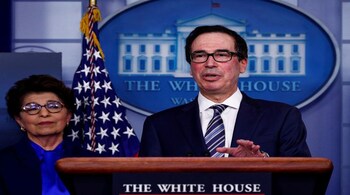
The United States opposes creation of liquidity through issuance of the International Monetary Fund's Special Drawing Rights (SDRs) as part of the response to the coronavirus pandemic, US Treasury Secretary Steven Mnuchin said on Thursday.
In a statement to the IMF's steering committee, Mnuchin said 70% of the funds created through an SDR allocation, something akin to a central bank "printing" new money, would go to G20 countries, most of whom did not need it, while only 3% would go to low-income countries.
The 24-member International Monetary and Financial Committee is meeting on Thursday to review the IMF's response to the pandemic and a possible SDR allocation that could provide hundreds of billions of dollars in urgently needed foreign exchange reserves for all of the IMF's 189 members.
The move was first floated by IMF Managing Director Kristalina Georgieva last month and is supported by many finance ministers, prominent economists and non-profit groups. But Washington, the IMF's dominant shareholder, is blocking an allocation because it would give new avenues of funding for Iran and China, Reuters reported this week.
SDRs based on dollars, euro, yen, sterling and yuan, are the IMF's official unit of exchange. Member countries hold them at the Fund in proportion to their shareholdings.
The IMF last approved a $250-billion new allocation of SDRs in 2009, boosting liquidity for cash-strapped countries during the last financial crisis.
"We recognize that a number of IMF members support a general Special Drawing Right (SDR) allocation to the membership," Mnuchin said in a text prepared for delivery to the committee. "In our view, an SDR allocation is not an effective tool to respond to urgent needs."
China's foreign ministry issued a pointed statement on the issue overnight, telling Reuters: "International financial institutions are important platforms for international cooperation, not political tools for a minority of countries to manipulate."
Mnuchin said a better, more-targeted approach would be for members to contribute to two IMF facilities that provide funds to the poorest countries, and the US government was exploring such a contribution itself.
Funded by grants from members, the IMF's Catastrophe Containment and Relief Trust (CCRT) has already provided grants to 29 countries to cover their debt service payments to the IMF for the an initial six-month period.
Members can also provide grants and loans to the IMF's Poverty Reduction Growth Trust, which supports low-income countries, Mnuchin said.
Follow our full coverage of the coronavirus pandemic here.
Discover the latest Business News, Sensex, and Nifty updates. Obtain Personal Finance insights, tax queries, and expert opinions on Moneycontrol or download the Moneycontrol App to stay updated!





