

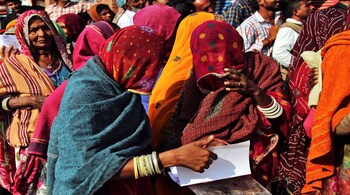
Should the government provide direct financial support to a citizenry pummeled by the pandemic, to boost consumption in the economy?
That’s the debate, which is dominating the echo chambers of civil society, pitting not just political parties, but also industry, economists and academia against each other.
In economics, public policy and social welfare, it is surely the most strident discourse in recent times.
India has, till now, tried various piecemeal ways to create a social safety net in the form of the public distribution system for food, unemployment dole, old age pension, financial grants to widows, funds for marriage of girl child and low interest loans for MSMEs (Micro, Small and Medium Enterprises), backward classes and castes.
But if implemented nationwide, an income support program will instantly become the largest in the world, overtaking all the welfare schemes mentioned above.
Why is income support being discussed?
While income support has been discussed over the past decade, if not more, the issue entered the national political lexicon before the 2019-20 elections.
Discussions have now gained pace as unemployment spikes and economic growth reels after two massive waves of COVID-19.
This has left large numbers of the urban poor and migrant workers without jobs, while multiple reports have shown that much of the rural poor have become financially vulnerable while the poorest of the poor are virtually going hungry.
Many have endorsed rescuing these groups from the clutches of hunger and poverty at least in the short term, while others make a case for giving systemic support to all citizens to supercharge demand in the economy.
What does Minimum Income Guarantee or Minimum Income Support mean?
Minimum Income Guarantee (MIG) is a social-welfare system that guarantees all citizens or families an income sufficient to live on, based on certain eligibility criteria. This typically includes a condition that the receiver has to be unemployed, be below the poverty line or earning lower than the national average.
Considered to be the last resort for a desperate population, MIG is a key part of welfare economics that lays stress on human dignity and the responsibility of the government to help out its citizens during crises.
Its most distinguishing feature is that it is provided on a temporary basis, helping the receiver gain control of their financial situation and move on.
It is also available to those who are actively trying to work but are rendered incapable due to lack of opportunity, poverty, discrimination or illness.
As a result, MIG has often been brought in globally, especially during economic and natural emergencies, or even at the time of natural calamities or public health disasters like the current pandemic.
Who are its backers or has similar plans?
The Congress Party had proposed the MIG plan before the 2019 General Elections, with Rahul Gandhi subsequently pushing it as NYAY or the Nyuntam Aay Yojana. It proposed that an amount of Rs 6,000 per month would be transferred to 25 crore people.
The plan has been further publicized by former Finance Minister and senior Congress leader, P Chidambaram. "Every economist of renown, every NGO working among the poor and practically every government around the world has supported the idea of an ‘income transfer’ to the poor," he recently wrote.
Former Reserve Bank of India governor Raghuram Rajan has also supported direct cash transfers provided they rationalize and subsume other subsidies given by the government.
In a recent interview with Moneycontrol, India's first Chief Statistician, Pronab Sen, disclosed that the government had in 2020 discussed a temporary income support of around Rs 5,000-6,000 per month for the urban and rural poor who had lost their livelihoods in the nationwide lockdown last year.
Industry body FICCI or the Federation of Indian Chambers of Commerce of Industry has also batted for targeted direct income support for the poor.
Nomura Chief Economist Sonal Verma had told Moneycontrol that a mechanism needs to be put in place to provide temporary income support to the poor.
What is Universal Basic Income?
In a fundamental sense, Universal Basic Income (UBI) is a process of regular cash transfer by governments to all citizens irrespective of their income or financial condition. The key aspect of UBI is the requirement to implement it over a long time to achieve stabilization and demand growth.
Unlike MIG, Universal Basic Income is globally considered a more potent tool to battle economic stagnation and deflation, as well as price shocks faced by citizens in a volatile or unstable economic environment.
It is supposed to be easily accessible, periodic, in the form of funds not vouchers or coupons, paid to individuals not households and unconditional, meaning the requirement to find work in a certain time frame is not mandatory.
As a result, while few countries have pure UBI in place, many in the developed world are currently testing out UBI-like schemes across Wales, Japan, Germany, and Chile.
Since governments commit to providing citizens with a legally stipulated and equal financial grant, it is also considered to be a form of social welfare, especially for those who are unemployed, sick and at the end of their working life.
Who has come out in support of it, or similar plans?
A UBI plan was first officially suggested by former Chief Economic Adviser Arvind Subramanian in the Economic Survey of 2016-17. It proposed that 75 percent of the population were to be provided with Rs 7,620 per annum, based on the official poverty line from 2011-12.
Subsequently updated twice, the plan had advocated for a fixed sum to each rural household, except those which were "demonstrably well-off". However, the Finance Minister back then, BJP leader Arun Jaitley had said the plan would face operational and political challenges in India.
Last year, Economics Nobel Laureate Abhijit Banerjee said India should immediately begin cash transfers of 1,000 per person per month as an ultra-basic version of UBI.
Who all are opposed to cash transfer?
In a recent interview with Moneycontrol, new Confederation of Indian Industry (CII) President, T V Narendran, said job creation through MGNREGA and other wide scale public expenditure is a much better plan to boost consumption in the short term as people will be assured of a dependable income stream.
NITI Aayog Vice Chairman Rajiv Kumar had told Moneycontrol that income transfer would result only in higher bank deposits.
Many have suggested that direct income support for a temporary period is a poor alternative to robust job creation and that government funds should instead be poured into infrastructure projects and public sector hiring to boost economic growth, going forward.
Others like Morgan Stanley's Chief India Economist, Upasana Chachra, in an interview with Moneycontrol earlier in June said such measures are not feasible from a fiscal deficit standpoint.
Which nations have cash transfer systems in place?
In 2020, countries worldwide resorted to cash transfer to help vulnerable citizens cope up with the economic turmoil posed by the pandemic.
Among the developed economies, where economic growth had stagnated, most cash transfers schemes have broadly adhered to the principles of UBI. However, austerity in government spending has meant the schemes have often cut out the rich and sometimes the urban upper middle income class.
Canada, provided $1,400 per month to those who lost income due to the COVID-19 pandemic. The United States offered its citizens cheques of $1,200 for individuals or $2,400 for those who were married.
After President Joe Biden took over, the US government distributed $600 to nearly every American adult starting in December of last year. A second bill, the American Rescue Plan Act, was enacted in March and offered cheques worth up to $1,400 for individuals, based on an individual’s income.
South Korea issued cash transfers of $820 for its citizens and Japan announced cash transfers of $931 per person.
On the other hand, many countries in South America, including Brazil, Chile and Argentina have implemented forms of partial unemployment schemes, which effectively subsidizes workers' incomes without work requirement.
What about the developing economies?
Since 2011, China has run the Minimum Livelihood Guarantee Scheme to provide cash transfers to the poor based on a locally set minimum income level.
During the pandemic, it expanded this to include almost all citizens in the country's vast rural hinterland.
The Arab Monetary Fund, which includes poorer economies like Iraq, Somalia, and Libya, have reached a consensus on the implementation of UBI set at 10 percent of the per capita income.
Egypt is soon set to begin trials of a minimum income guarantee scheme, but for a large segment of the population.
The birthplace of the idea of modern nations providing direct cash to stimulate growth and ensure minimum living standards is the Scandinavian region of Europe - Denmark, Norway, Finland and Sweden.
These nations implemented their own variety of Nordic welfare systems back in the 1970s at a time when none of them were considered rich. The world caught up with them later.
Discover the latest Business News, Sensex, and Nifty updates. Obtain Personal Finance insights, tax queries, and expert opinions on Moneycontrol or download the Moneycontrol App to stay updated!





