

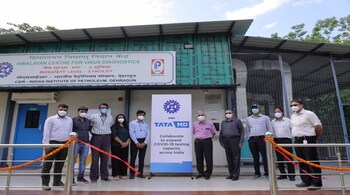
The Centre for Scientific and Industrial Research (CSIR) and Tata Medical and Diagnostics (Tata MD) have partnered to ramp up COVID-19 testing in Tier II and III towns and rural areas.
The ministry of science and technology on June 18 said India’s top scientific research organisation and Tata Group’s healthcare business were developing the capacity to manage any future surge in COVID-19 testing requirements.
To be jointly developed, the RT-PCR CRISPR tests will use Tata MD’s CHECK SARS-CoV-2 test kits, which are powered by CSIR-IGIB’s FELUDA technology and Tata MD’s CHECK Automated testing solution.
Follow our LIVE blog on the COVID-19 pandemic here
As of now, 13 CSIR labs are engaged in RT-PCR testing for COVID-19 and the new partnership aims to expand the capacity over the next few months to 37 laboratories.
CSIR Director-General Dr Shekhar C Mande said that rapid testing and isolation of SARS-CoV-2 positive patients had “emerged as the best strategy in combating COVID-19” along with vaccines, and called this an “important step to augment national capacity to test and detect COVID locally”.
Tata MD will also deploy a proprietary three-room design mobile testing lab that can conduct end-to-end, on-site COVID-19 testing.
Tata Medical and Diagnostics CEO and MD Girish Krishnamurthy said he was confident that the deployment of the fully equipped mobile labs would allow for quick augmentation of testing capacity.
“This will significantly enhance the ability of state and district administrations to ensure wider availability and easier access to testing on an on-going basis,” he said.
The first CSIR lab to go live is the CSIR-Indian Institute of Petroleum (IIP) in Dehradun and institute's director Dr Anjan Ray was happy the current capacity of 800 tests/day can be significantly scaled up if demand rises.
Tata MD CHECK SARS-CoV-2 test is a paper strip based RT-PCR CRISPR test approved by the Indian Centre for Medical Research (ICMR) and requires standard laboratory equipment like thermocyclers. Tata MD CHECK Automated testing solution can be deployed in existing NABL II approved molecular labs and Tata MD mobile testing labs.
Discover the latest Business News, Sensex, and Nifty updates. Obtain Personal Finance insights, tax queries, and expert opinions on Moneycontrol or download the Moneycontrol App to stay updated!





