

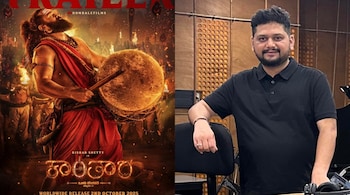
Acclaimed music director B. Ajaneesh Loknath, the creative force behind the haunting and deeply rooted soundscape of Kantara, has redefined how Indian cinema experiences sound. Known for his ability to blend tribal authenticity with cinematic grandeur, Ajaneesh’s compositions have become the heartbeat of Rishab Shetty’s universe. In an exclusive conversation with Moneycontrol, the composer spoke about his journey from rejection to recognition, the painstaking research that went into building the sonic identity of Kantara Chapter 1, and how imagination, history, and emotion intertwine in his music. From recording live tribal percussions to collaborating with Diljit Dosanjh, Ajaneesh shared his artistic philosophy with striking honesty.
Acclaimed composer B. Ajaneesh Loknath, the man behind the soul-stirring soundscape of Kantara, has redefined how rooted Indian folk can blend with cinematic power. Known for crafting atmospheres that feel both ancient and alive, Ajaneesh spoke about his creative process, research, and the long road from rejection to recognition. In an exclusive chat with Moneycontrol, he poured his heart out.
When Kantara began, Ajaneesh already had a foundation. “When we started Kantara, we already had a soundscape from the first part, which was released two years ago,” he recalled. “We needed the same kind of rooted music. All the percussions were recorded live—we went to the actual tribal locations, met the people, and captured their sounds.”
For Kantara Chapter 1, the challenge was bigger. “Visually it’s massive, but I had to maintain that raw, grassroots energy. So, I infused both tribal and electronic elements. Nobody knows how music sounded 1,500 years ago, so I used imagination—tribal rhythms, dramatic tones, and new-age synths—to give the film that cinematic grandeur.”
Ajaneesh didn’t just aim to recreate history—he wanted to make it emotionally immediate. “That’s the beauty—nobody really knows how it was. We researched Carnatic and North Indian traditions, but organized Carnatic music came only 500–600 years ago. Before that, music was mostly tied to mantras and rituals.”
He pointed to one song as a key example. “If you listen to the Brahma Kalesha song, the rhythm—ta-ta-ta, ta-ta-ta—comes from that mantra tradition. Folk and tribal forms existed even earlier, so I used their percussions, flutes, and vocals to bring authenticity. But when royal dynasties like Kadamba appear in the film, I introduced orchestral and grander tones.”
His sound design walks the line between physical and spiritual. “The hero plays the dhol. Whenever the tribal community appears, you’ll hear only dhol, flutes, and voices. Even the vocal effects—those chants and cries—are my own imagination of what their soundscape might have been.”
Then there’s the rebel anthem, powered by the unmistakable voice of Diljit Dosanjh. “That song is basically a warning to the king. It needed a voice that could scream and carry anguish,” Ajaneesh explained. “Punjabi singers have that powerful throat and high range. Diljit was a collective choice between me, Rishab, and the production team. I’ve always followed his music, so getting him on board was a joy.”
Behind that confidence lies decades of persistence. “My journey started more than 20 years ago,” he said quietly. “Rejection is a part of evolution. I came from a musical family, but not from cinema. That world was alien to me.”
He remembered walking from one radio and TV office to another, carrying his compositions. “People wouldn’t believe in me. I didn’t want to perform others’ songs—I wanted to compose my own. I made songs for college events, Independence Day, anything that gave me a chance to create.”
Even when a producer finally took a chance, success didn’t come easily. “I had done some jingles and TV work, but no one would give me a film because they’d ask, ‘What have you done before?’ Finally, after six or seven years, I found a producer. Even then, my first films didn’t succeed.”
His turning point arrived through a chance encounter. “One day, an editor named Rakesh Chetty heard my song and liked it. He introduced me to Rishab Shetty. Rishab was working as an associate director back then. They told me, ‘You’re doing the music for Ulidavaru Kandante.’ That changed everything.”
That project opened the floodgates. “That film gave me recognition not just for songs but for background score,” Ajaneesh said. “Then came Rangitaranga, Kirik Party, Avane Srimannarayana, and finally Kantara. Each film taught me something about storytelling through sound.”
He paused, thoughtful. “It’s been a long road, but music has always been my truth. I just wanted people to feel something ancient and alive again—and that’s what Kantara gave me.”
Discover the latest Business News, Sensex, and Nifty updates. Obtain Personal Finance insights, tax queries, and expert opinions on Moneycontrol or download the Moneycontrol App to stay updated!





