

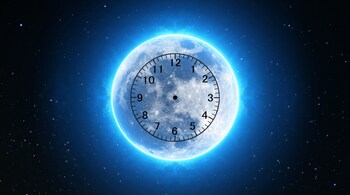
Time on the Moon passes slightly faster than on Earth—a phenomenon rooted in Einstein's theory of general relativity. This effect, known as gravitational time dilation, occurs because time moves more quickly in weaker gravitational fields. Since the Moon's gravity is about one-sixth that of Earth's, clocks on the lunar surface tick faster.
The Science: Why Does Time Move Faster?
Time and gravity are intricately linked. Einstein’s theory explains that stronger gravitational fields, like Earth’s, slow down the passage of time, while weaker fields, like the Moon’s, allow time to move faster. With the Moon’s gravity being just one-sixth of Earth’s, clocks on the lunar surface run quicker.
How much faster, you ask? According to calculations by NASA’s Jet Propulsion Laboratory, a clock on the Moon would gain 56 microseconds per day compared to an identical clock on Earth. While microseconds may seem trivial, this discrepancy becomes significant for precise lunar navigation, communication, and extended missions.
Why Does This Matter for Space Exploration?
As humans prepare for sustained lunar exploration and habitation, understanding this time discrepancy is crucial. Imagine a scenario where different mission teams operate on mismatched timelines—it could lead to catastrophic errors in navigation, communication, or even crew safety.
Recognizing this, NASA, along with international space agencies, is working to establish a unified lunar time standard. Dubbed Coordinated Lunar Time (CLT), this system will synchronize all lunar missions. The goal is to have this standard in place by 2026, ensuring flawless collaboration between nations and missions on the Moon.
The Future of Lunar Timekeeping
Coordinated Lunar Time will not just keep astronauts on schedule; it will also lay the foundation for long-term lunar habitation. As space agencies plan missions like building lunar habitats and mining resources, accurate timekeeping becomes a cornerstone for efficiency and safety.
Why Should You Care?
This small difference in time highlights the profound interplay of gravity and relativity. It’s a reminder of how space exploration challenges our understanding of fundamental physics and demands innovative solutions for survival beyond Earth.
So, the next time you look up at the Moon, remember: while its time ticks faster than ours, humanity’s journey to understand and conquer this cosmic difference is just beginning.
Discover the latest Business News, Sensex, and Nifty updates. Obtain Personal Finance insights, tax queries, and expert opinions on Moneycontrol or download the Moneycontrol App to stay updated!





