

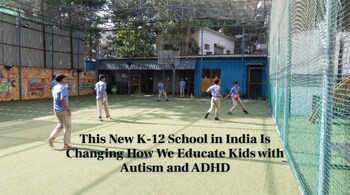
When Dr. Sonam Kothari founded Butterfly Learnings, it was with a singular vision: to provide high-quality therapy for neurodiverse children. But just a year into launching her pilot centres in Thane and Dombivli, it became clear that therapy alone wasn't enough. The gap between therapy and education loomed large—and children with autism, ADHD, and intellectual disabilities were falling through the cracks.
“In mainstream schools, these children are often ignored, reprimanded, or asked to leave,” Dr. Kothari recalls. “They’re expected to ‘manage’ with a shadow teacher, but that’s not inclusion. That’s neglect.”
That realization led to the birth of BLISS—an ambitious, full-spectrum K-12 education model that blends therapy with academics for neurodiverse learners. And with it, Dr. Kothari is attempting what few have dared: building a parallel yet inclusive system that could change the way India educates children with special needs.
At BLISS, no two children have the same timetable—and that's by design. “We begin with a comprehensive assessment to understand each child’s developmental and educational profile,” she explains. The result is a tailored curriculum that could include a mix of remedial classes, behavioral therapy, academics, and life skills training—all in a single day, under one roof.
Younger children may follow the Disha curriculum (Nursery to L3), while older students can opt for NIOS Grades A, B, or C, and eventually progress to 10th or 12th through open schooling. Children with severe intellectual disabilities are trained in functional independence. Those on the higher-functioning end of the spectrum are coached in language and academics up to Senior KG, with the goal of mainstream integration.
A key pillar of the BLISS philosophy is the thoughtful integration of Finnish pedagogy with Indian functional learning. “It’s not a cut-and-paste job,” Dr. Kothari clarifies. “We use Finland’s child-led, play-based methods but balance them with India’s practical needs—NIOS pathways, functional skill-building, and curriculum flexibility.”
Instead of pushing a child to “fit in”, BLISS molds the learning environment around the child’s pace and strengths. Individual learning pathways, embedded therapies, and adaptive teaching strategies form the backbone of this hybrid framework.
But BLISS goes beyond academics and therapy. Teachers and therapists are trained to spot hidden interests, from music and arts to numbers and nature. With class sizes of just 5 to 10 students, every child gets personalized attention. “We start with shadow teaching but slowly fade it out as the child gains confidence,” says Dr. Kothari.
Vocational training, life skills modules, and interest-based activities are all part of the roadmap. It’s a system where potential isn’t just supported—it’s celebrated.
BLISS currently operates from its inclusive school in Thane, but the model is built for thoughtful expansion. “We’ll start by embedding inclusive classrooms within mainstream CBSE, ICSE, and SSC schools,” Dr. Kothari shares. These partnerships will create dedicated resource rooms, integrated learning support, and specialized curriculum delivery—all on existing campuses.
The school follows a dual-pathway model: children can transition from the Disha curriculum to NIOS for recognized certification, while neurotypical children continue with standard national board curricula. Regulatory approvals are handled through partnerships with established schools, while BLISS itself is working toward direct NIOS affiliation.
To prepare for this integrated model, BLISS has developed a month-long teacher training program: 15 days of behavioral and skills training, followed by 15 days of academic and therapeutic integration. “We use role-playing, hands-on sessions, and mentoring by senior educators,” says Dr. Kothari. Small class ratios and a layered support system ensure that both teachers and students feel empowered.
While many parents of neurodiverse children spend heavily on separate therapy, shadow teaching, and school fees, BLISS offers an affordable, all-inclusive alternative. “Our fees are only 10–20% more or less than regular schools,” she says. The integration of therapy and academics reduces logistical strain—and financial burden—especially for middle-class and economically weaker families.
Early response from families has been nothing short of encouraging. Parents are eager to send their children to a “normal-looking” school where they feel understood and included. “Their only concern is distance,” admits Dr. Kothari. “And we’re already planning how to address that.”
Because for BLISS, this isn’t just a school—it’s a movement. A long-overdue push toward educational equity, where success isn’t defined by grades alone, but by independence, self-worth, and potential realized.
“In the long run,” Dr. Kothari says, “we want to build a world where every child—regardless of IQ, diagnosis, or ability—has the tools to thrive. That’s the bigger goal behind BLISS.”
Discover the latest Business News, Sensex, and Nifty updates. Obtain Personal Finance insights, tax queries, and expert opinions on Moneycontrol or download the Moneycontrol App to stay updated!





