

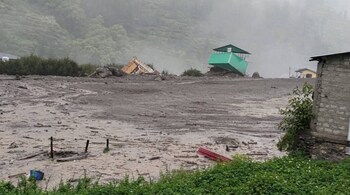
Two remote Himalayan villages, separated by hundreds of kilometres, have been levelled by sudden, violent floods in a matter of days, raising urgent questions about the real causes of such disasters in fragile mountain regions.
Dharali in Uttarkashi was struck on August 5, followed by Chasoti in Jammu & Kashmir’s Kishtwar on August 14. Both communities, which rely on pilgrim traffic and apple and walnut orchards, saw temples, bridges and farmland vanish in minutes. The events were initially attributed to cloudbursts, a common but often misused term in the mountains.
However, a report from TOI reveals that meteorological records tell a different story. The rain measured in the hours leading up to each disaster was too little and too scattered to have unleashed such catastrophic flooding. Furthermore, neither village had a local weather monitoring system to record what truly happened.
This contradiction has led scientists to propose a more alarming possibility: that these were Glacial Lake Outburst Floods (GLOFs), catastrophic events triggered when water bodies dammed by melting glaciers or unstable moraine walls suddenly rupture.
The distinction is critical. If the primary cause was not intense rainfall, the risks faced by mountain communities are even more unpredictable and difficult to monitor than previously assumed.
The mystery is underscored by eyewitness accounts. Suresh Chander, 49, was at his dhaba near the stream in Chasoti at noon on August 14 when the deluge arrived.
He was cited by TOI as saying, “On the night of August 13, there was no heavy rain. Even the next day, only a thin drizzle, the kind that barely makes you wet. I was at my dhaba when the water came down and we just ran.” His family survived, but his 75-year-old uncle, Dina Nath, a priest at one of three temples destroyed in minutes, was lost. “I grow apples, but what kept us going was the yatra season,” he said.
Official data supports his observation. The India Meteorological Department (IMD) gauges near Dharali logged only low rainfall totals on August 5, even as floods struck, leaving one dead and 68 feared dead and halting the Gangotri yatra. In Chasoti, the district recorded almost no rain on August 14, with duty officers reporting only intermittent drizzle. Yet, torrents of water, rocks and mud swept down the valleys. The official toll in J&K reached 70 on Thursday, with an equal number missing. Chief Minister Omar Abdullah has said it is “nearly impossible” they would be found alive.
Mukhtar Ahmed, director of the meteorological centre in Srinagar, confirmed to TOI that satellite data indicated some rainfall activity over Chasoti and a linkage to Ladakh’s glacier-rich Zanskar valley. However, he admitted the recorded rainfall was far too low to account for the flooding.
“The nearest weather station at Gulabgarh - just 2–3 km aerially from the site - recorded only 4–5 mm of light rain on Aug 14. Such limited rainfall cannot generate a flash flood of this magnitude,” Ahmed said. He suggested something occurred in the upper catchment, possibly intense localised rainfall in several valleys that funnelled down into one.
He also noted, as cited by TOI, a key parallel between the two events: “Both areas have glaciers in their upper catchments and in both cases, the flash floods carried down unusually large boulders of extraordinary size.”
Anand Sharma, president of the Indian Meteorological Society and former additional director general of IMD, echoed these concerns. He stated that the available data does not support the cloudburst theory and stressed the urgent need for improved data collection from high-altitude catchment zones to understand the triggers.
“Rain-bearing clouds are typically large-scale systems. To attribute such devastation to a tiny, hyper-localised cloudburst does not align with meteorological science,” Sharma was quoted by TOI as saying. Researchers warn that the official reliance on ‘cloudburst’ as a blanket explanation risks obscuring the complex realities of Himalayan disasters. While Doppler radars can track extreme rainfall, they cannot anticipate a glacial dam breach or a slope collapse.
The National Disaster Management Authority has already identified dozens of potentially dangerous glacial lakes across Uttarakhand, Himachal Pradesh and J&K. Yet, monitoring remains limited and warnings rarely reach the communities living directly in the path of potential destruction.
Amid the scientific debate, infrastructure projects in the regions continue. The government has proposed a strategic Paddar–Zanskar road to link Jammu with Ladakh, with plans for a new route via Chasoti and an 8-km tunnel. For the survivors in Dharali and Chasoti, however, these debates and promises feel distant as they grapple with their losses and face an uncertain future, wondering if and when the next disaster will strike.
Discover the latest Business News, Sensex, and Nifty updates. Obtain Personal Finance insights, tax queries, and expert opinions on Moneycontrol or download the Moneycontrol App to stay updated!





