

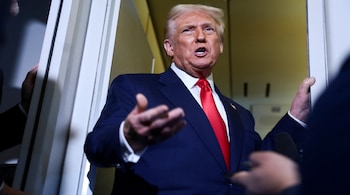
Just days after US President Donald Trump cleared Nvidia to resume exports of its high-end H200 artificial intelligence chips to China, Beijing is preparing to impose its own limits. According to people familiar with internal discussions, Chinese regulators are considering an approval mechanism that would require buyers to justify their need for the chips and explain why domestic alternatives cannot meet their technical demands. The move reflects a core tension defining China’s semiconductor strategy: maintaining access to world-class hardware while accelerating its drive for self-sufficiency, the Financial Times reported.
The H200 is Nvidia’s second-most powerful generation of AI chips and an essential component for training large models. The Biden administration previously restricted sales over concerns that the chips could enhance China’s military capabilities. Trump’s reversal, which he announced after speaking with President Xi Jinping, was framed as a “win-win”, accompanied by his claim that 25 per cent of the sales revenue would be paid to the US government. Policy experts note that no legal structure currently exists for such a levy.
China balances global tech access with industrial policy goals
Beijing’s hesitation is not entirely surprising. Over the past two years, China has used US export controls as a catalyst to deepen its semiconductor localisation campaign. Regulators have tightened customs checks, increased scrutiny of foreign chip imports and rolled out incentives for data centres adopting Chinese-made processors. Allowing unrestricted access to Nvidia’s most advanced chips risks undermining the leverage used to pressure domestic champions such as Huawei, Biren and Cambricon to accelerate development.
Officials are therefore discussing measures that would give Chinese companies limited access while ensuring foreign technology does not displace emerging national alternatives. Options include requiring approval requests, restricting public-sector purchases of the H200, and strengthening reporting requirements for companies seeking to integrate US chips into cloud and research operations.
Why tech giants want Nvidia chips despite patriotic pressure
For China’s leading technology platforms — including Alibaba, ByteDance and Tencent — Nvidia’s hardware remains the industry gold standard. Although these companies have integrated more domestic chips for lower-tier inference workloads, they still prefer Nvidia GPUs for complex model training, citing reliability, ecosystem maturity and ease of maintenance. Because of US restrictions, many have been forced to shift their most advanced training runs offshore to markets where high-end Nvidia clusters are available.
This dependence explains why Trump’s announcement was met with quiet optimism among China’s AI developers. Yet a controlled-access framework means that any relief will be partial. Tech executives expect competition for approval to be intense, and many anticipate that regulators will favour companies working on state-aligned strategic applications.
Political backlash grows in Washington as Congress weighs intervention
The export decision has also triggered resistance in the US. A bipartisan group of senators has proposed legislation that would block exports of advanced chips — including the H200 — to China for 30 months. While the bill’s prospects are unclear, it underscores the widening political divide: Republicans who once demanded tighter controls under the Biden administration have been far more muted now that Trump has authorised a major relaxation.
Nvidia has lobbied heavily to regain access to the Chinese market, which accounted for a significant share of its data-centre revenue before the sanctions took effect. But analysts warn that even if exports resume, geopolitical uncertainty will make planning difficult for both the company and its Chinese customers.
A new phase in the US-China chip rivalry
The emerging arrangement captures a broader reality of the US-China tech conflict: neither side wants to be fully cut off, yet both fear dependence. Washington’s priority is preserving strategic advantage, while Beijing is determined to avoid long-term vulnerability in a sector it sees as foundational to national power.
Whether limited access to the H200 becomes a temporary compromise or a long-term framework will depend on how quickly Chinese firms close the performance gap. For now, a chip once viewed as a geopolitical flashpoint may return to China — but only on Beijing’s terms.
Discover the latest Business News, Sensex, and Nifty updates. Obtain Personal Finance insights, tax queries, and expert opinions on Moneycontrol or download the Moneycontrol App to stay updated!





