

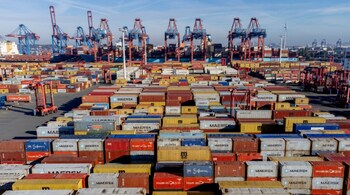
US President Donald Trump's wide-ranging new tariffs mark the official end of a period of US-led globalisation that had governed the world economy for almost eight decades. Tariffs now aimed at over 100 nations, the US has left behind the post-World War II agreement that advocated open markets, multilateral trade agreements, and cross-border investment as the driver of global stability and prosperity, the Washington Post reported.
From architect of free trade to global disruptor
US presidents, from Truman through Obama, have been globalisers' standard-bearers for generations, establishing institutions such as the World Trade Organization and concluding gigantic trade agreements like NAFTA. This paradigm increased 1.5 billion individuals out of poverty and doubled the size of the US economy. Yet it created losers and winners: highly skilled workers and companies profited greatly, and numerous American manufacturing employees lost their jobs or had their wages plateau.
The surge of economic nationalism
Trump has complained about the global trading system for years, claiming it "stole from" American workers and favoured other countries at US cost. His government has now levied the highest tariffs since 1909, employing trade deficits as a crude calculator to set rates. By doing so, Trump is wagering that protectionism, coupled with domestic reindustrialisation, will bring a new economic golden age.
Markets and economists are sceptical
It has mainstream economists in doubt. Trump's announcement has led to JPMorgan analysts flagging a 60% threat of world recession through retaliatory tariffs, and the S&P 500 declined by 5%. Even if Trump's assumption that investment and factory jobs would pour back to the US turns out to be true, experts believe it won't happen overnight, especially with industries like automotive manufacturing, where foreign-originating parts remain necessary.
Though imperfect, globalisation sparked tremendous economic growth, reduced consumer prices, and avoided another world war. But neglect to aid displaced workers—through poorly funded retraining initiatives such as Trade Adjustment Assistance—left much of society behind. Politically, the uneven benefits paved the way for populism backlash, which reached its peak in Trump's victory in 2016.
New world, unclear rules
The imposition of tariffs at such short notice has made firms and partners confused about prospective trade regulations. People are worried that Trump's approach does not have a definite endpoint—either if it is for pressuring nations to sign new agreements or remaking the world economy on a long-term basis. "Nobody knows what the permanent tariff is going to be. You can't plan," Christopher Meissner, an economist, said.
Toward a more regional trade system
As global integration fails, specialists predict a trend toward regional trade blocs. Asian exporters such as Vietnam suffer harsh US duties, but Latin American countries like Brazil and Costa Rica are subjected to only 10% tariffs, which indicates that the US will give preferential treatment to near neighbours. However, economists caution that regionalisation will cut efficiency and inflate costs.
Services trade still rising—but US leadership fading
Trump's protectionist policies only hit physical goods for now. Services—finance, tourism, digital content—keep on expanding across the world. But US allies are already pushing back at the new order: Canada indicates that it will look elsewhere than the US for trade, and the EU is making deals with India. China and Brazil are forging deeper economic ties.
A new era begins
Harvard economist Carmen Reinhart referred to this as the "nail in the coffin of globalisation." The Trump administration, however, welcomes the change. "Today, we're in one era, and tomorrow we will be in a different era," a senior White House official stated, highlighting the administration's willingness to disrupt decades of global economic dominance.
Discover the latest Business News, Sensex, and Nifty updates. Obtain Personal Finance insights, tax queries, and expert opinions on Moneycontrol or download the Moneycontrol App to stay updated!





