

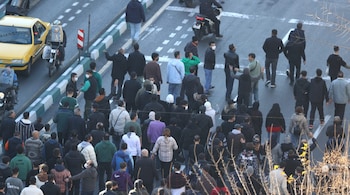


Iran is witnessing its most serious street unrest in three years as economic collapse and political anger spill onto the streets of major cities. Over the past two days, protests have erupted across Tehran, Mashhad, Isfahan, Shiraz and several smaller towns, driven by a plunging currency and deepening frustration with the clerical regime led by Ayatollah Ali Khamenei.
The immediate trigger has been the free fall of the Iranian rial, which has crashed past 42,000 to the US dollar. Inflation has surged beyond 42 percent, sharply eroding purchasing power in a country of more than 92 million people. Prices of food, medicine and basic necessities have soared, pushing many Iranians to the brink.
Videos shared on social media show large crowds chanting openly against the Islamic Republic. Iranian-American journalist and author Masih Alinejad described the mood on the streets in a post on X.
“Many videos are coming in from Iran, showing people chanting in unison in the streets: ‘Mullahs must leave Iran’ and ‘death to the dictatorship...’ This is the voice of a people who do not want the Islamic Republic.”
The unrest poses a major challenge for Iran’s leadership, which is already under pressure after Israeli and US strikes on nuclear-linked facilities and renewed economic sanctions. The situation has raised a larger question in diplomatic circles. Is this simply domestic anger boiling over, or has years of US pressure finally turned into political leverage?
A powerful image circulating among Iranian expatriates has intensified global attention. It shows a lone man sitting motionless in the middle of a Tehran highway as regime forces on motorcycles move in. Jason Brodsky, policy director of United Against Nuclear Iran, compared the scene to the iconic image from China’s Tiananmen Square crackdown in 1989. Other Iran watchers claimed that pro-Shah slogans were also heard, invoking memories of the monarchy that was overthrown during the 1979 revolution led by Khamenei.
Iranian state media acknowledged the protests but attempted to minimise their political nature. Government-run Islamic Republic News Agency said the unrest was limited to economic complaints and reported that mobile phone vendors were protesting the rial’s sharp fall. However, even semi-official agency Fars admitted that some slogans had gone “beyond economic demands”.
Why are protests erupting now?
Iran last saw protests of this scale in 2022 and 2023 after the death of Mahsa Amini in the custody of the morality police. Those demonstrations shook the regime and drew global condemnation over the violent crackdown that followed.
On Monday, clashes were reported in Tehran and Mashhad as security forces used batons and tear gas. Central Tehran, home to key government buildings and markets, became a flashpoint. Videos showed demonstrators inside Tehran’s Grand Bazaar chanting, “Have no fear, we are all together.” They also hurled insults at security forces, calling them “shameless”, according to Fox News.
The collapse of the rial has pushed traders, shopkeepers and small businesses onto the streets. News agency Associated Press reported that the crisis led to the resignation of Central Bank chief Mohammad Reza Farzin. But economists and analysts say the anger goes far beyond numbers. Many Iranians see the current hardship as the result of decades of mismanagement, corruption and ideological rule.
Former US Secretary of State Mike Pompeo blamed Iran’s leadership directly.
“It’s no surprise that the people of Iran are taking to the streets to protest the collapsing economy... The Iranian regime has ruined what should be a vibrant and prosperous country with its extremism and corruption... The people of Iran deserve a representative government that serves their interests — not those of the mullahs and their cronies.”
Is there a US factor behind the unrest?
At a deeper level, Iran’s crisis cannot be separated from international sanctions. The rial’s slide began after the US withdrew from the 2015 nuclear deal under Donald Trump and launched a “maximum pressure” campaign that cut oil revenues and isolated Iran financially.
Renewed tensions after the Iran-Israel conflict, fresh UN sanctions and Trump’s push for nuclear disarmament have added to the pressure. Trump has also linked Iran to regional instability, pointing to Tehran’s support for Hamas. On Monday, he warned of fresh action against Iran and said Hamas would have “hell to pay” if it failed to disarm in Gaza during a meeting with Israeli Prime Minister Benjamin Netanyahu.
Iranian President Masoud Pezeshkian has tried to strike a softer tone, saying, “The livelihood of the people is my daily concern.” But experts argue that the damage has already been done.
Economist Amir Hossein Mahdavi told the New York Times that without sanctions relief or deep spending cuts, the risk of “sustained high inflation” would only increase. For ordinary Iranians, shrinking incomes and rising prices have turned daily life into a constant struggle.
Responding to a post by US Ambassador Mike Waltz backing the protests, Iranian-origin Canadian politician Goldie Ghamari asked on X, “Did the United States just give the green light for regime change in occupied Iran? This is huge ”.
What is unfolding on Iran’s streets appears to be the result of long-simmering failures catching up with the theocratic system. US sanctions and military pressure may have tightened the screws, but the unrest itself reflects public exhaustion with clerical rule. Whether or not Washington intended this moment, Iran’s leadership is now facing one of the most serious tests of its authority in years.
Discover the latest Business News, Sensex, and Nifty updates. Obtain Personal Finance insights, tax queries, and expert opinions on Moneycontrol or download the Moneycontrol App to stay updated!





