

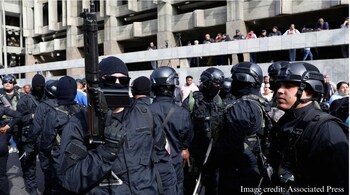


The US military mission that targeted Venezuelan leader Nicolás Maduro was launched at the request of the US Justice Department, according to Dan Caine, the chairman of the Joint Chiefs of Staff.
The operation was codenamed 'Absolute Resolve,' a signal, US officials say, that this was framed as a law-enforcement driven mission backed by military force.
Scale and preparation: 150 aircraft across the hemisphere
Caine said the operation involved around 150 aircraft launching from multiple locations across the hemisphere, one of the most detailed public descriptions yet of the scale of US involvement.
Planning drew heavily on decades of US counterterrorism experience in the Middle East, Southwest Asia, and Africa — not traditional state-to-state warfare, but raid-style missions aimed at extracting high-value targets.
Clearing the skies over Caracas
According to Caine, US warplanes first dismantled Venezuelan air defences, creating a corridor for American helicopters to enter Caracas.
“One of our aircraft was hit but remained flyable,” he said, indicating that Venezuelan forces did engage during the operation, though US aircraft were not forced down.
The ground phase: helicopters and extraction teams
Once air defences were neutralised, helicopters moved into the capital. The main force was followed by a dedicated “extraction force” whose sole task was to secure Maduro.
Caine said the youngest service member involved was 20, the oldest 49 — underscoring the mix of junior and seasoned personnel.
A second set of helicopters was later dispatched specifically to extract Maduro and his wife, Cilia Flores. That team also came under fire during the mission.
Two hours, twenty minutes
From start to finish, the entire operation lasted about two hours and 20 minutes, Caine said, a compressed timeline designed to overwhelm Venezuelan forces before they could reorganise.
No US fatalities, second wave held in reserve
President Donald Trump said no American service members were killed, though he had earlier suggested there may have been casualties.
Trump added that the US was prepared to carry out a second wave of strikes if necessary, but said it was not needed due to what he described as the success of the first phase.
Trump’s framing: historic force, no equal
Opening his Mar-a-Lago news conference, Trump described the operation as a show of “overwhelming American military power,” deployed from air, land and sea. He compared it to past US actions, including strikes on Iran’s nuclear sites, and claimed “no other nation” could execute a mission of this scale.
He went further, calling it a force not seen since World War II, remarks delivered while appearing visibly fatigued after staying awake most of the night.
The aftermath: control claimed, control contested
While Trump said the United States would now “run” Venezuela, senior figures in Maduro’s government appeared on state television rejecting that claim. Venezuela’s defence minister, attorney general, and several governors issued defiant statements, insisting they still controlled the country and calling for international condemnation of the US operation.
Discover the latest Business News, Sensex, and Nifty updates. Obtain Personal Finance insights, tax queries, and expert opinions on Moneycontrol or download the Moneycontrol App to stay updated!





