

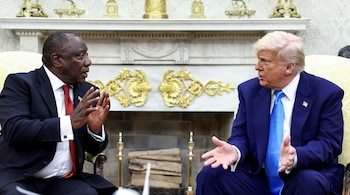
Relations between the United States and South Africa have deteriorated sharply after Donald Trump boycotted the G20 summit in Johannesburg last month and later declared that South Africa “will not be receiving an invitation” to the 2026 G20 in Miami. Trump justified his actions by alleging violent abuses against white Afrikaners — claims firmly rejected by South Africa.
Johannesburg hosted the G20 Leaders’ Summit on 22 and 23 November, the first time the forum had been held on African soil. While leaders from 42 countries attended, the United States was the only G20 member without senior-level representation. Only a US embassy official attended in a ceremonial capacity as the incoming host nation.
Trump had made his intention to boycott clear in advance, framing the absence as a political protest.
Claims of abuse drive Trump’s boycott
Trump outlined his reasoning through a series of posts on Truth Social. He accused the South African government of ignoring what he described as “horrific Human Rights abuses” against white Afrikaners and “other descendants of Dutch, French, and German settlers”. He wrote: “To put it more bluntly, they are killing white people, and randomly allowing their farms to be taken from them.”
He further claimed that “Afrikaners are being killed and slaughtered, and their land and farms are being illegally confiscated”. He concluded that “the United States did not attend the G20 in South Africa because the South African Government refuses to acknowledge or address” these alleged violations.
Trump also attacked the American press, stating: “Perhaps, worst of all, the soon to be out of business New York Times and the Fake News Media won’t issue a word against this genocide.” South African authorities have repeatedly denied any such genocide.
He subsequently described the summit as “a total disgrace”, adding: “No US Government Official will attend as long as these Human Rights abuses continue.”
A ceremony turns into a diplomatic flashpoint
Customarily, the outgoing G20 host symbolically passes the presidency to the incoming chair during the summit’s closing session. As part of this tradition, Cyril Ramaphosa formally concluded the Johannesburg meeting by saying: “This gavel of this G20 summit formally closes this summit and now moves on to the next president of the G20, which is the United States, where we shall see each other again next year.”
Trump later alleged that Ramaphosa “refused to hand off the G20 Presidency” to the US embassy official present. South Africa disputes this account. Ramaphosa later clarified that since no senior American officials attended, “the gavel and other instruments of the G20 Presidency” were handed to a US embassy official at South Africa’s foreign ministry headquarters.
This dispute became the backdrop to Trump’s next escalation.
Following the summit, Trump declared: “At my direction, South Africa will not be receiving an invitation to the 2026 G20, which will be hosted in the great city of Miami, Florida next year.” He added: “South Africa has demonstrated to the world they are not a country worthy of Membership anywhere, and we are going to stop all payments and subsidies to them, effective immediately.”
Pretoria rejects Washington’s ultimatum
South Africa issued a blunt rebuttal. In an official statement, the presidency said: “South Africa is a member of the G20 in its own name and right. Its G20 membership is at the behest of all other members.”
The statement added that South Africa “does not appreciate insults from another country about its worth in participating in global platforms” and said it was “regrettable that despite the efforts and numerous attempts by President Ramaphosa and his administration to reset the diplomatic relationship with the US, President Trump continues to apply punitive measures against South Africa based on misinformation and distortions”.
Ramaphosa said South Africa would remain “a full, active and constructive member” of the G20. On the US absence, he remarked: “Their absence is their loss.”
In a social media post, he added:
“It is regrettable that the United States of America, which is a founding member of the G20 and which takes over the Presidency of the G20 from South Africa in 2026, chose not to participate in the G20 Leaders’ Summit and the final meetings leading up to it.…”
Ramaphosa’s spokesman, Vincent Magwenya, told the BBC that G20 members “should by now accept there won’t be a reset of the relationship” and warned that if visas were denied next year, “we will have to move on and look beyond the G20 in the US.”
Can the United States legally exclude a G20 member?
There is no formal legal mechanism allowing a G20 country to expel another member. The forum, established in 1999, is an informal grouping whose membership changes require consensus. Even when Joe Biden suggested Russia be excluded in 2022, Moscow still attended via its foreign minister.
While Trump cannot formally remove South Africa, he could deny visas to its officials, preventing their physical attendance in Miami — a de facto exclusion without legal expulsion.
CNN has reported that the United States may seek to invite Poland as a guest to the summit. Poland’s finance minister has said the country’s “aspirations to join the G20 are entirely justified”. Permanent membership, however, would require unanimous approval.
'White Genocide' claim and its policy impact
Trump’s dispute with South Africa centres on a long-running allegation that white farmers are being targeted. The claim has circulated for years in far-right online circles and has been amplified by Elon Musk.
Trump has repeatedly asserted that “they are killing white people” and that farms “are being illegally confiscated”. He linked this to South Africa’s Expropriation Act and cited South Africa’s genocide case against Israel at the International Court of Justice.
These claims have shaped policy. Trump cut US foreign aid to South Africa, offered to resettle Afrikaners, and 59 white South Africans arrived in the US as refugees in May. He later capped refugees at 7,500 for 2026, prioritising white South Africans.
What official crime figures indicate
South African police data does not support claims of targeted racial killings. Of the 26,232 murders recorded in 2024, only 44 were linked to farming communities, and just eight victims were farmers. White farmers account for under 1 per cent of annual murder victims.
In the final quarter of 2024, a dozen murders occurred on farms nationwide. White South Africans still own most private land, and land restitution has largely proceeded through courts.
Gareth Newham, of the Institute for Security Studies, told PBS: “If there was any evidence of either a genocide or targeted violence taking place against any group based on their ethnicity, we would be amongst the first to raise the alarm and provide the evidence to the world.” He added that robbery was the dominant motive.
What the standoff means for future
South Africa is the United States’ second-largest single-country trading partner after China. Bilateral trade reached $26.2 billion in 2024, according to US figures. Yet politically, the relationship is at its lowest point in years.
Earlier in 2025, the US expelled South Africa’s ambassador and cut foreign aid under a Trump executive order targeting Pretoria’s policies. With visas now in question, attention has turned to whether South Africa will even be able to attend the Miami summit — a decision that could further harden a diplomatic rupture already nearing breaking point.
(With inputs from agencies)
Discover the latest Business News, Sensex, and Nifty updates. Obtain Personal Finance insights, tax queries, and expert opinions on Moneycontrol or download the Moneycontrol App to stay updated!





