

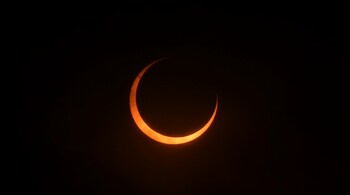
A rare and spectacular celestial event will occur on August 2, 2027, when a total solar eclipse crosses parts of Europe, Africa and the Middle East. During a total solar eclipse, the Moon moves directly between the Earth and the Sun and blocks the Sun completely for a short period. What makes the 2027 eclipse extraordinary is its length. In some locations, the total phase will last for more than six minutes, making it the longest total solar eclipse that many people alive today will ever witness. Scientists and skywatchers are calling it one of the most important astronomical events of the century.
What will happen during the eclipse
As the Moon covers the Sun, the sky will slowly darken until it looks like twilight. In the path of totality, the Sun will disappear completely and the corona will become visible. The corona is the Sun’s outer atmosphere, which forms a glowing halo around the darkened Moon. Temperatures may drop slightly and animals and birds may show unusual behaviour. People outside the path of totality will experience a partial eclipse, where only a portion of the Sun is covered.
Why this eclipse is rare
The 2027 eclipse is considered exceptional because of its long duration. Totality will reach up to six minutes and twenty three seconds, which is far longer than most total solar eclipses. Such long eclipses occur only when the Moon is close to the Earth and appears large enough to cover the entire Sun. At the same time, the Earth will be farther from the Sun, making the Sun appear slightly smaller. This combination creates a longer period of darkness. It is also rare for such a long eclipse to pass over large land areas, giving millions of people a chance to see it.
Where the eclipse will be visible
The path of totality will begin over the Atlantic Ocean and move across Spain, including cities such as Cádiz and Málaga. It will then pass over Gibraltar before entering North Africa, covering parts of Morocco, Algeria, Tunisia and Libya. From there it will move into Egypt, where Luxor will experience the longest duration of totality. The eclipse will continue across Saudi Arabia, Yemen and finally toward the Horn of Africa, passing over Somalia before ending over the Indian Ocean.
Many other regions in Europe, Africa, the Middle East and parts of Asia will see a partial eclipse. In India, cities such as New Delhi and Mumbai will see only a partial event, not total darkness.
Date and time of the eclipse
The eclipse will occur on August 2, 2027. The exact time depends on where observers are located. In India, the partial eclipse will begin in the afternoon and end before sunset. In regions under the path of totality, the full eclipse will occur at different times as the Moon’s shadow moves eastward across the continents.
How to watch the eclipse safely
Watching a solar eclipse requires proper eye protection. The Sun should never be viewed directly without certified solar viewing glasses or filters. Regular sunglasses do not provide protection. People can also watch the eclipse through telescopes or cameras fitted with approved solar filters. Only during the brief period of totality, when the Sun is fully covered, can observers safely look at the sky without filters. For those experiencing a partial eclipse, protective eyewear must be used at all times.
What to expect globally
The 2027 eclipse is expected to attract millions of travellers, scientists and photographers from around the world. Many will visit cities like Luxor and Málaga to witness the longest moments of darkness. The event will also create economic activity in regions along the path, as hotels, tour operators and local businesses prepare for increased tourism. For the scientific community, the eclipse offers a rare opportunity to study the Sun’s corona and its magnetic structure.
Discover the latest Business News, Sensex, and Nifty updates. Obtain Personal Finance insights, tax queries, and expert opinions on Moneycontrol or download the Moneycontrol App to stay updated!





