

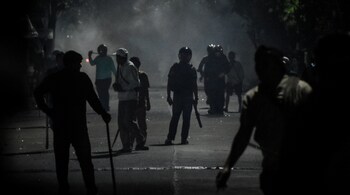
Indonesia has been rocked by its deadliest protests in years, leaving at least eight people dead and forcing President Prabowo Subianto into his biggest political test since taking office in October.
On Monday, thousands of people took to the streets across Indonesia while the military was deployed in the capital, Jakarta. The unrest has spread far beyond Jakarta, with major protests reported in Sulawesi, Sumatra, Java, Borneo and other regions.
In Jakarta, around 500 people rallied outside parliament under heavy guard from soldiers and police. President Prabowo warned that demonstrations must end by sundown. Outside the capital, protests turned more violent. In Gorontalo on Sulawesi, demonstrators clashed with police who fired tear gas and water cannon, AFP reported. In Bandung, protesters hurled Molotov cocktails and firecrackers at a council building. In Makassar, three people died after protesters set fire to a regional parliament office, while another person was killed by a mob in a case of mistaken identity.
Police checkpoints and patrols have been set up across Jakarta. Snipers have been deployed at key locations and schools and universities in the capital are conducting classes online. Civil servants have also been told to work from home.
TikTok has suspended its live-streaming feature in Indonesia for “a few days” due to fears of unrest.
What triggered the protests?
The demonstrations began last week in Jakarta, initially over a generous housing allowance for lawmakers. Parliament members were set to receive 50 million rupiah a month (about Rs 2.69 lakh), nearly ten times the minimum wage in Jakarta.
Students, workers, and activists called the perks “lavish” and demanded they be withdrawn. A student group called Gejayan Memanggil said they were also protesting against “corrupt elites” and policies that benefit big businesses and the military.
The protests escalated after the death of 21-year-old motorcycle delivery rider Affan Kurniawan. On August 28, Affan was reportedly completing a food delivery order when he was run over by an armored police vehicle in Jakarta. Footage of the incident went viral, sparking public outrage and drawing anger at the elite police unit involved.
“The problems piled up like dried hay, and the parliament lit the fire,” said Bhima Yudhistira Adhinegara, executive director of the Center of Economic and Law Studies, in comments to AFP.
Widening unrest and looting
After Affan’s death, demonstrations quickly spread beyond Jakarta. In Makassar, a fire at a parliament building killed three people. In Yogyakarta, a student was killed in clashes. Protesters also torched cars and vandalized public buildings in Bandung and Surabaya.
Looting has worsened the crisis. The house of Finance Minister Sri Mulyani Indrawati was attacked and ransacked, AFP reported. Lawmaker Ahmad Sahroni also became a target after he mocked demonstrators by calling them “the dumbest people in the world.” Videos on social media showed protesters breaking into his house, destroying his car, and carrying away luxury bags, watches, and even his bathtub.
“The Indonesian government is a mess. The cabinet and parliament will not listen to the people’s pleas,” 60-year-old snack seller Suwardi told AFP near parliament. “We have always been lied to.”
How Prabowo is responding
President Prabowo has tried to calm the situation. On Sunday, he announced that some perks for lawmakers would be revoked and a moratorium imposed on overseas trips. He also promised support for Affan’s family and said an investigation into police violence was underway.
On Monday, police accountability chief Agus Wijayanto said that two officers, including the driver of the van that ran over Affan, had committed criminal acts. “They could be dishonourably discharged,” he told reporters.
However, Prabowo has also taken a hard line against the protests. During a hospital visit to injured police, he said: “The law states that if you want to demonstrate, you must ask for permission, and permission must be granted, and it must end at 6:00 pm.”
He warned of “signs of extrajudicial, even unlawful, actions… some even leading to treason and terrorism.”
Prabowo has cancelled his planned trip to China for the Shanghai Cooperation Organisation summit and a military parade marking the end of World War II, citing the unrest.
Will Prabowo survive the crisis?
Experts believe the protests are unlikely to topple the president but say he faces a serious challenge to his authority.
“The government must resolve deep-rooted problems,” said Muzammil Ihsan, head of the All Indonesian Students’ Executives Body, to Reuters. “The anger on the streets is not without cause.”
Made Supriatma, a visiting fellow at Singapore’s ISEAS-Yusof Ishak Institute, told AFP: “If I were the president, I’d remove the National Police chief from his post. The people need a symbolic gesture from him.”
Ray Rangkuti, a political analyst at the Lingkar Madani think tank, told CNA that while the unrest is serious, “judging from the scale of the unrest, it is unlikely (to spread to Prabowo).”
Discover the latest Business News, Sensex, and Nifty updates. Obtain Personal Finance insights, tax queries, and expert opinions on Moneycontrol or download the Moneycontrol App to stay updated!





