

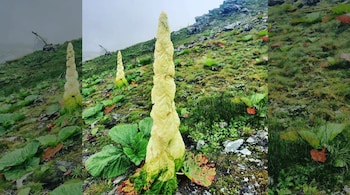
When business leader Anand Mahindra pauses to marvel at nature, it’s usually something extraordinary. This time, it’s a rare Himalayan wonder — the Sikkim Sundari, a towering alpine plant that looks like a glowing glass structure rising from the mountains of Sikkim.
Sharing his fascination on X, Mahindra drew attention to this little-known botanical marvel, calling it yet another compelling reason to explore the higher reaches of Sikkim — a destination he has often described as an “underrated paradise”.
A plant that waits decades to bloom
Known scientifically as Rheum nobile, the Sikkim Sundari grows at extreme altitudes of 4,000 to 4,800 metres in the Eastern Himalayas. What makes it remarkable isn’t just its appearance, but its life story.
For 7 to 30 years, the plant exists quietly as a low rosette of leaves, enduring freezing temperatures, fierce winds and intense ultraviolet radiation. Then, in a single dramatic phase, it shoots up to nearly two metres (around 6.6 feet), forming a striking pagoda-like structure. It blooms once, releases its seeds — and completes its life cycle.
Mahindra described this slow, purposeful growth as a “masterclass in patience,” adding that such extraordinary natural stories are often missing from school biology lessons.
Why it’s called the ‘Glasshouse Plant’
The Sikkim Sundari is often referred to as the “Glasshouse Plant” — and the name is well earned. Its tall cone is made up of translucent, straw-coloured bracts edged with pink. These overlapping layers allow sunlight to pass through while shielding the flowers inside from biting cold and harmful UV rays.
The result is a natural greenhouse effect, creating a warmer microclimate that helps the plant survive at high altitudes. Against stark mountain slopes, its pale, glowing structure can be spotted from far across alpine valleys.
Where can you see the Sikkim Sundari?
While most closely associated with Sikkim, the plant grows across high-altitude regions of the Himalayas, including parts of Nepal, Bhutan, Tibet, Afghanistan and Pakistan. In Sikkim, it thrives on open hillsides and rocky alpine slopes, standing tall like a natural monument amid rugged terrain.
Spotting one in bloom is rare — and often described as a once-in-a-lifetime experience for trekkers and nature lovers.
Why Sikkim deserves a place on your bucket list
Beyond this rare botanical wonder, Sikkim offers a rich mix of landscapes and culture. From glaciers, alpine meadows and vibrant wildflowers to ancient Buddhist monasteries like Pemayangtse, the state blends natural beauty with deep spiritual calm. Add to that sweeping views of Kangchenjunga, India’s highest peak, and Sikkim emerges as one of the most rewarding destinations in the Himalayas.
Mahindra himself recently questioned why Sikkim hasn’t yet become a global travel hotspot. In a post, he wrote that rediscovering the state feels overdue — and admitted he felt he had “deprived himself of exquisite beauty” by not visiting yet.
A reminder from the mountains
The story of the Sikkim Sundari is more than botanical trivia. It’s a quiet reminder of resilience, patience and the wonders that exist far from crowded tourist trails. For travellers seeking experiences beyond the obvious — and landscapes that inspire awe — Sikkim, and its once-blooming ‘glasshouse’ flower, offer a rare and poetic reason to go higher.
Discover the latest Business News, Sensex, and Nifty updates. Obtain Personal Finance insights, tax queries, and expert opinions on Moneycontrol or download the Moneycontrol App to stay updated!





