

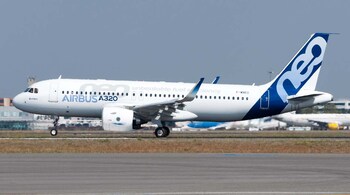
Airlines across the world faced mass flight cancellations and delays after Airbus instructed operators to ground more than 6,000 A320-family aircraft for urgent software fixes. The directive was issued following an incident involving a JetBlue A320 in October, where the aircraft suddenly dropped altitude without pilot input. An investigation traced the behaviour to a corrupted flight-control computer, prompting what is now considered the largest recall in Airbus’s history.
What triggered the grounding
The emergency action began after a JetBlue flight travelling from Cancun to Newark experienced an uncommanded nose-down movement. The aircraft was forced to divert and land in Tampa, with investigators later determining that data corruption inside the ELAC 2 computer caused the behaviour. ELAC, short for Elevator Aileron Computer, manages key flight-control surfaces that regulate pitch and roll.
Airbus engineers subsequently confirmed that intense solar radiation can interfere with the software running on specific ELAC units, leading to corrupted data and potential uncommanded manoeuvres. While rare, such interference poses an unacceptable risk, especially on fly-by-wire aircraft where computers govern most control inputs.
How the software glitch works
The A320 family relies on redundant flight-control computers, with ELAC units playing a central role. The glitch is rooted in how the software processes and validates data during spikes in atmospheric radiation. At cruising altitudes—typically above 28,000 feet—charged particles released during solar storms can penetrate aircraft electronics. If these particles disrupt specific data pathways, corrupted values may reach the control surfaces.
In the JetBlue case, corrupted data led the aircraft to interpret faulty signals as legitimate inputs, causing the sudden altitude drop. Although pilots were able to regain manual control, the event exposed a critical vulnerability that required manufacturer-wide mitigation.
Scale of grounding and global impact
The directive affected roughly half of the global A320 fleet. Major US carriers, including American Airlines, Delta, JetBlue, and United, reported immediate operational disruptions during one of the busiest travel periods of the year. American Airlines initially estimated more than 300 affected jets before revising its figure to 209, with each fix taking around two hours per aircraft. Delta expected limited impact, while Avianca temporarily halted ticket sales after confirming that nearly three-quarters of its fleet required updates.
Across Europe and Asia, operators also faced cancellations. Air France grounded multiple aircraft, Japan’s ANA cancelled dozens of services, and Indian carriers IndiGo and Air India issued delay advisories as maintenance teams rushed to deploy patches.
What the fixes involve
Airbus instructed airlines to install updated ELAC software that can better manage data anomalies caused by solar radiation. For most aircraft—estimated at around 4,000 units—the fix involves rolling back to a stable earlier software version. This process can be completed in a few hours.
However, approximately 1,000 older A320-family aircraft require hardware replacements in addition to software changes. These jets will remain grounded for weeks, depending on parts availability and maintenance capacity.
The A320 family was one of the earliest large-scale adopters of fly-by-wire systems, where software and electronics play a major role in flight safety. The current issue underscores how environmental factors such as solar storms can influence aircraft electronics and why continuous software audits remain essential.
Regulators, including the European Union Aviation Safety Agency, have now issued emergency airworthiness directives prohibiting flights until updates are applied. Airbus has apologised for the disruption but emphasised that safety remains its primary priority.
Discover the latest Business News, Sensex, and Nifty updates. Obtain Personal Finance insights, tax queries, and expert opinions on Moneycontrol or download the Moneycontrol App to stay updated!





