

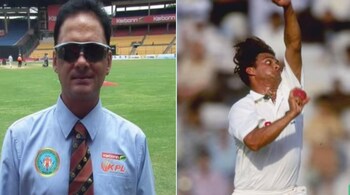
“Deeply saddened by the passing of my former teammate, David Johnson,” said the tweet from Sachin Tendulkar. “He was full of life and never gave up on the field. My thoughts are with his friends and family.”
Tendulkar and Johnson, who passed away after falling from the fourth floor of his Bengaluru apartment on June 20, were inextricably linked. In the first Test as India captain, the one debutant that Tendulkar had in his ranks was Johnson, a shock selection for the game against Australia in New Delhi. On a typically dusty Kotla pitch, Johnson would bowl just 16 overs across two innings, scalping Michael Slater for a duck in the second.
That he was then chosen to tour South Africa was even more surprising. Johnson, fairly short but possessing the pace bowler’s aggression, had caught the eye at various training camps held for the national team in Bengaluru in the early 1990s. At a time when India had barely any out-and-out pacers to speak of, Johnson offered something different.
But though he played nearly a decade for Karnataka, Johnson was never an automatic selection. In 1995-96, he took a 10-for against Kerala in the Ranji Trophy, but wasn’t part of the win against Tamil Nadu in the final – Karnataka’s first success in the competition since 1982-83.
Despite that, it was Johnson that was called up for the Delhi Test, part of what was seen as a new era for Indian cricket. Three of Johnson’s Karnataka teammates – Rahul Dravid, the present-day India coach, Venkatesh Prasad and Sunil Joshi – had made their debuts on the tour of England a few months earlier, while Anil Kumble and Javagal Srinath were already cornerstones of the Test side.
Karnataka would win the Ranji Trophy thrice in four years, but Johnson wouldn’t play a single one of those finals. Srinath and Prasad were the first picks, and when they weren’t around, Dodda Ganesh had moved ahead of Johnson in the pecking order. Whenever there was a gathering or function to celebrate those glory years, Johnson would stay away from the spotlight and quietly remind you that he didn’t play a Ranji final.
He would play one more Test, the Boxing Day game in Durban in 1996. He dismissed Herschelle Gibbs and Brian McMillan in the first innings before being struck a painful blow on the shoulder by Allan Donald when India batted. With his arm movement restricted, he made next to no impact in the second innings. And in keeping with the skewed logic that was pervasive in Indian cricket at the time, it was Johnson that was dropped after the batsmen had been skittled for 100 and 66.
He never played for India again, and represented Karnataka for the final time half a decade later. In retirement, there was a bit of coaching and a few other gigs, but he never really found his niche. And unlike the IPL millionaires of today, there was no cosy nest egg to fall back on either.
The record books may tell you that Johnson didn’t quite make it as an international cricketer. And while there may be some truth in that, the bigger reality is that Indian cricket failed him.
Discover the latest Business News, Sensex, and Nifty updates. Obtain Personal Finance insights, tax queries, and expert opinions on Moneycontrol or download the Moneycontrol App to stay updated!





