

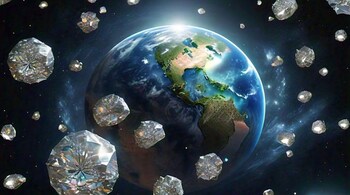
As Earth's warming trends intensify, scientists are urgently exploring novel ways to cool the planet. A recent study in Geophysical Research Letters proposes an ambitious idea: injecting diamond dust into the atmosphere to reflect sunlight and reduce global temperatures. The study, conducted by a team of climate scientists, utilised 3D climate models to analyse seven different reflective materials. To their surprise, diamond dust emerged as the most effective option, reflecting the highest amount of light and heat while remaining airborne for ideal durations without clumping.
Safe Alternative: How Diamond Dust Compares to Sulfur Dioxide
The use of diamond dust is not only innovative but could also be safer than current methods. Sulfur dioxide, a leading choice for atmospheric cooling, poses environmental risks such as acid rain and ozone depletion. In contrast, diamond dust is chemically inert, meaning it wouldn’t introduce harmful side effects into the ecosystem.
The study estimates that if around five million tonnes of synthetic diamond dust were injected annually, global temperatures could drop by 1.6°C over 45 years. Yet, researchers highlight a major challenge: the astronomical cost. Funding this solution could require a staggering $200 trillion—a sum that raises questions about feasibility.
Read Also: US astronaut sips ketchup straight from the bottle while floating in space, watch video here
Despite these costs, the proposal underscores the lengths scientists may need to go to counteract climate change. As the planet teeters on a tipping point, innovative solutions like diamond dust reflect both the potential and complexity of geoengineering in climate intervention.
Discover the latest Business News, Sensex, and Nifty updates. Obtain Personal Finance insights, tax queries, and expert opinions on Moneycontrol or download the Moneycontrol App to stay updated!





