

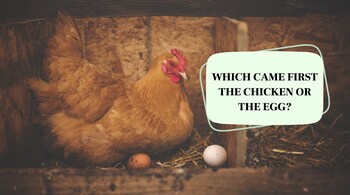
The timeless riddle — "Which came first: the chicken or the egg?" — has puzzled humanity for centuries. But thanks to evolutionary biology, science has a pretty clear answer: the egg.
At its core, the debate is a fascinating exploration of cause and effect, but when viewed through the lens of evolution, the answer is more straightforward. Eggs, in their simplest form as female reproductive cells, existed long before chickens. The breakthrough came with the evolution of hard-shelled amniotic eggs, which appeared around 325 million years ago, according to the University of Texas at Austin's Biodiversity Center. These eggs allowed vertebrates to reproduce on land, freeing them from water-based reproduction.
Birds, including chickens, evolved much later. True birds are thought to have first appeared in the fossil record roughly 150 million years ago, during the Jurassic period. Long before chickens arrived, dinosaurs and other land-dwelling vertebrates were laying eggs with hardened shells.
However, when we shift the question to the "chicken egg," things get a little more complicated. Chickens (Gallus gallus domesticus) are believed to have evolved from a subspecies of red jungle fowl (Gallus gallus) about 50 million years ago. The process of domestication, which began between 1650 B.C. and 1250 B.C. in Southeast Asia, involved selective breeding and genetic changes. At some point, a proto-chicken laid an egg containing a genetically distinct embryo, marking the emergence of the first true chicken.
This means the egg, in its broader sense, predates chickens by millions of years. But the "chicken egg," defined as an egg laid by a chicken, came after the first chicken itself.
Discover the latest Business News, Sensex, and Nifty updates. Obtain Personal Finance insights, tax queries, and expert opinions on Moneycontrol or download the Moneycontrol App to stay updated!





