

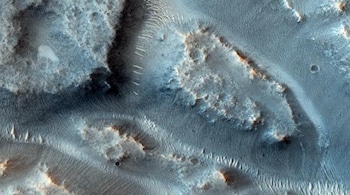

- Chinese scientists have identified eight unusual caves on Mars’ Hebrus Valles that appear to have formed through water-driven chemical erosion rather than volcanic activity. Using NASA satellite data, the study suggests these karst-like structures could have provided sheltered environments capable of preserving signs of past microbial life, making them promising targets for future Mars exploration missions.

Chinese scientists have identified unusual cave formations on Mars that may have been shaped by ancient water activity, offering new clues about the planet’s geological past and its potential to once support life.
An international research effort led by Chinese scientists has revealed eight cave-like openings in the Hebrus Valles region of Mars. The discovery, reported by the Daily Galaxy, suggests these structures differ sharply from previously known Martian caves formed by volcanic processes.
Instead, the newly identified features appear to have developed through chemical erosion caused by underground water flow, a process common on Earth but never before confirmed on Mars. The findings were published on 30 October 2025 in The Astrophysical Journal Letters, using data collected from several NASA missions, including the retired Mars Global Surveyor.
Water-shaped caves on ancient Mars
The caves were located in the northwestern portion of Hebrus Valles, where researchers observed eight deep, circular openings with strikingly similar characteristics. Unlike impact craters, these formations lack raised rims or surrounding debris fields. Scientists identified them as skylights, created when the ceilings of underground cavities collapse, revealing voids below the surface. This structural pattern set them apart from known lava tubes found elsewhere on Mars, suggesting a very different formation process.
Further analysis focused on the chemical composition of rocks surrounding the cave openings. Data from NASA’s Thermal Emission Spectrometer revealed the presence of carbonates and sulfates, minerals typically associated with long-term interactions between water and soluble rock. Researchers concluded that flowing groundwater likely dissolved underground bedrock, gradually forming karst-like caves. On Earth, similar landscapes develop over extended periods in limestone-rich regions shaped by water chemistry.
Possible shelters for ancient Martian life
The discovery has important implications for the search for life beyond Earth. Mars’ surface has long been hostile, exposed to intense radiation, dust storms, and extreme temperature changes. According to EarthSky, scientists believe subsurface environments such as these caves may have provided protection for microorganisms if life ever emerged on the planet. Karst caves could have offered stable temperatures, shielding fragile biological material from destruction.
Such underground spaces may also preserve chemical or biological traces far better than surface rocks. Protected from radiation and erosion, caves could retain signs of past microbial activity for billions of years. Researchers say these sites should become high-priority targets for future robotic missions and, eventually, human exploration.
What the discovery means next
While the findings significantly expand understanding of Martian geology, scientists caution that further confirmation is needed. Direct imaging and in-situ measurements will be required to fully understand the caves’ structure and composition. Still, the discovery strengthens evidence that Mars once hosted active water systems beneath its surface.
By revealing a previously unknown geological process on Mars, the study opens new directions for planetary science. It also reinforces the idea that Mars was once far more dynamic and potentially habitable than it appears today.
Discover the latest Business News, Sensex, and Nifty updates. Obtain Personal Finance insights, tax queries, and expert opinions on Moneycontrol or download the Moneycontrol App to stay updated!





