

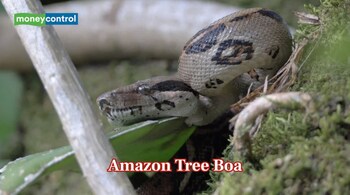
Deep in the Amazon canopy, a shy tree boa moves with silent confidence. Its body glides across branches that shift with the passing winds. According to scientists, this is not some simple trick of muscle and balance. Instead, it reflects special skin features shaped for life high above ground. New research now explains how these tiny scale structures influence survival in the rainforest.
How the Boa’s Skin Affects Tree Movement
The boa lives in dense rainforests across northern South America. It spends most time several metres above the forest floor. A study in the Journal of Comparative Physiology found its skin works like a climbing tool. Ventral scales carry long ridges that reduce forward friction. Dorsal and lateral scales show net-like patterns that increase sideways grip.
Researchers measured friction on surfaces of different roughness. Ventral scales recorded coefficients near 0.191 during forward motion. Dorsal and lateral scales reached values around 0.323 and 0.331 respectively. These figures show why the snake moves smoothly upwards yet resists slipping sideways. The study used electron microscopy to reveal how each region supports precise arboreal movement.
How the Boa Hunts Among Forest Branches
The Amazon tree boa hunts mainly at night in high branches. It remains stationary until birds or mammals approach. The heat-sensing pits will help it to detect warm prey outlines in poor light. When the prey is near, the snake strikes quickly and holds the animal for a short period of time. Adults feed on birds, bats, and rodents, whereas the young snakes choose smaller prey.
Its prehensile tail acts as an anchor during hunting. The slender body fits through vines and narrow branches. These features allow the boa to reach prey that ground predators cannot reach. Researchers say its behaviour reflects canopy hunting efficiency and careful biomechanical control.
Why the Boa's Adaptations Matter for Forest Balance
The study shows how scale structure influences movement and predation. Efficient climbing helps the boa make effective use of forest space. Its hunting success affects bird and mammal numbers across the canopy. These food-web effects help shape seed spread, insect levels and forest structure. The snake’s skin therefore links directly to wider ecological patterns.
Scientists note that the species remains listed as Least Concern. However, threats to rainforest cover still pose risks. Changes in canopy structure may alter movement surfaces for arboreal organisms. Understanding scale mechanics can help conservationists better prepare for such changes. The research also supports advances in biomimetic design for engineering fields.
Discover the latest Business News, Sensex, and Nifty updates. Obtain Personal Finance insights, tax queries, and expert opinions on Moneycontrol or download the Moneycontrol App to stay updated!





