

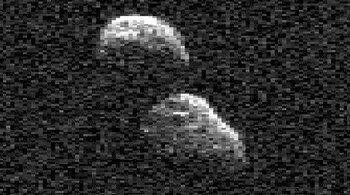
Asteroid Named 2024 ON, flew safely past Earth on 17 September, travelling at a staggering speed of 19,842 mph (31,933 kph). Measuring 1,150 feet (350 metres) in length, the skyscraper-sized asteroid passed at a safe distance of 620,000 miles (1 million kilometres) from Earth—more than 2.5 times the average distance between the Earth and the Moon.
While NASA classifies 2024 ON as "potentially hazardous," it poses no immediate threat to Earth. Recent radar imaging from NASA's Jet Propulsion Laboratory using the Goldstone Solar System Radar significantly reduced the uncertainty around the asteroid's future orbit, ruling out any danger for the foreseeable future.
Safe distance but fascinating shape
What's intriguing is the asteroid's peculiar shape. It is a contact binary, meaning it is made of two smaller asteroids that fused together, likely due to their gravitational pull. The peanut-shaped rock has two distinct lobes, with one nearly 50% larger than the other. Bright spots on the asteroid’s surface suggest the presence of large boulders.
Approximately 14% of near-Earth asteroids over 660 feet (200 metres) are classified as contact binaries. Selam, the moonlet orbiting the near-Earth asteroid Dinkinesh, is the most famous example. However, unlike Selam, 2024 ON drifts through space without an orbiting partner.
Even though asteroids like 2024 ON are classified as hazardous, they rarely pose real danger. NASA defines "potentially hazardous" as any object passing within 4.6 million miles of Earth's orbit. But thanks to ongoing observations, astronomers have catalogued over 60 asteroids that passed between Earth and the Moon this year, and none posed a serious threat.
No asteroid threat for the next century
Later this autumn, asteroid 2024 PT5 will briefly become Earth's second moon. For two months, starting 29 September, the 33-foot-long asteroid will follow a horseshoe-shaped orbit around Earth before being drawn back to its usual path around the Sun.
NASA's forecasts for near-Earth asteroids show that no major threat is expected for at least the next 100 years, giving us peace of mind as we continue to explore the wonders of our universe.
Discover the latest Business News, Sensex, and Nifty updates. Obtain Personal Finance insights, tax queries, and expert opinions on Moneycontrol or download the Moneycontrol App to stay updated!





