

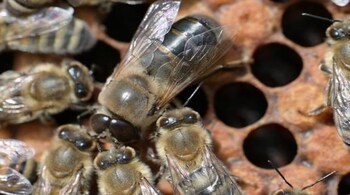
Male honeybees, also called drones, rely entirely on worker bees for food. A new study reveals that a single gene may control their begging behaviour. This discovery challenges long-held assumptions about social behaviour in insects. Could one tiny gene really orchestrate life-or-death interactions in a hive?
What Did the Study Reveal?
Researchers identified the gene “fruitless” (Fru) as a key player. It influences how drones behave when trying to obtain food from workers. Drones cannot digest pollen themselves and depend entirely on workers feeding them.
The Fru gene affects neural circuits that control social decision-making. When the gene is inactive, drones beg less and fail to get fed. Other behaviours and physical traits remain unaffected, suggesting a highly specific role.
Who Conducted the Study and Where?
The research was led by scientists at the University of Lausanne, Switzerland. Their work focused on interactions between drones and workers in experimental hives. The results were published in the journal Nature Communications, gaining global attention. It highlights how even small genetic changes can profoundly affect social systems.
Unexpected Insights Into Hive Dynamics
The study also reveals how intricate and interdependent hive societies are. Drones rely completely on workers, yet their behaviour is finely tuned by genetics. Even small disruptions in Fru activity can affect food distribution in the colony. This shows that social coordination in bees may be more genetically guided than imagined.
How Was This Study Conducted?
The team used CRISPR-Cas9 gene editing to label the Fru gene with fluorescent markers. They mapped its activity in the drone brain, tracing the neural pathways. By switching off the gene, they observed drones begging significantly less. This confirmed the gene’s role in specific social behaviour, without affecting other traits.
Could similar genetic mechanisms influence other social animals?
Understanding Fru opens new doors to studying how genes shape communication and cooperation. It challenges the idea that complex social interactions are purely learned. The research may even inform robotics and AI systems mimicking collective behaviour.
While Fru is a major player, researchers suspect other genes also influence drone behaviour. Future studies may uncover networks of genes orchestrating social tasks in hives.
Discover the latest Business News, Sensex, and Nifty updates. Obtain Personal Finance insights, tax queries, and expert opinions on Moneycontrol or download the Moneycontrol App to stay updated!





