

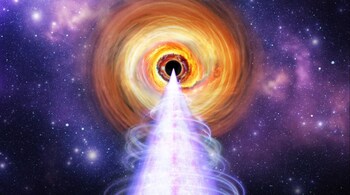
Stargazing tends to raise more questions than solutions. Yet occasionally, a fleeting cosmic phenomenon provides a glimpse of clarity. That was precisely the case when astronomers looked towards a far-off blazar—BL Lacertae. Thanks to NASA's IXPE satellite and an array of telescopes, a long-standing mystery of black hole jets finally received its solution.
Blazar's Bright Disk Hints at Deeper Truths
BL Lacertae is a blazar—a kind of galaxy with a supermassive black hole and high-energy jets pointing toward Earth. Researchers had long argued over how they generate energetic X-rays. Either protons or electrons were their guesses. Both leave their own signature in the polarisation of the X-ray light.
If X-rays were very polarised, protons would be to blame. If polarisation was low, electrons would be at fault. This polarisation had to be measured, and only one satellite could do that: IXPE. Launched in December 2021, IXPE is designed to read X-ray polarisation.
Scientists joined forces with radio and optical telescopes all over the globe. The mission monitored BL Lac in late November 2023 for seven consecutive days. Meanwhile, ground telescopes also monitored optical and radio polarisation. IXPE had previously observed BL Lac, but now it was different.
BL Lac's optical polarisation reached 47.5%—its strongest in 30 years. "This is the most polarised any blazar has ever been," said project-leading astrophysicist Ioannis Liodakis.
X-ray Signals Point to Electrons, Not Protons
In spite of the powerful optical signals, polarisation of X-rays was much weaker. IXPE determined it couldn't be more than 7.6%. That eliminated protons and directly implicated electrons. Scientists believed that electrons scatter photons of light via a phenomenon known as Compton scattering.
Compton scattering occurs when light goes at high speeds, colliding with rapidly moving electrons. These electrons travelling at nearly the speed of light give photons a kick—converting them to X-rays. "This was one of the largest enigmas," said Iván Agudo, lead author and Spanish astronomer. "IXPE, assisted by ground telescopes, allowed us to solve it."
Steven Ehlert, IXPE mission scientist, corroborated this. "The difference in polarisation between X-rays and optical light can only be accounted for by Compton scattering," he stated.
Mission Continues to Decode Cosmic Secrets
IXPE is a collaborative effort of NASA and the Italian Space Agency. Its data is provided by an international team from 12 countries. The spacecraft is operated by BAE Systems and the University of Colorado's space laboratory. Its aim is to crack cosmic mysteries using polarised X-ray vision.
Enrico Costa, a founding scientist of the mission, declared it a success. "IXPE has answered some old long-standing questions. This one is one of the most significant," he explained.
And what's next? "We want to see more of these blazars," Ehlert said. "They keep evolving and surprising us."
BL Lac can be a single blazar, yet it has already contributed to reauthorising the rules of how X-rays form around black holes. By means of a superb cosmic coincidence, researchers finally obtained a missing component.
Discover the latest Business News, Sensex, and Nifty updates. Obtain Personal Finance insights, tax queries, and expert opinions on Moneycontrol or download the Moneycontrol App to stay updated!





