

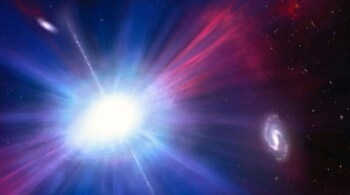

- Astronomers using the James Webb Space Telescope have detected the most distant known supernova, exploding when the universe was just 730 million years old. Linked to a powerful gamma ray burst, the event appears surprisingly similar to supernovae seen nearby today. The finding challenges assumptions about how early stars evolved under extreme conditions and opens a new window into stellar deaths during the universe’s first billion years.

Astronomers using the James Webb Space Telescope have confirmed the most distant supernova ever observed, capturing the explosive death of a massive star from a time when the universe was only about 730 million years old. The finding, reported in Astronomy and Astrophysics in December 2025, offers a rare glimpse into the era of reionisation, when the first galaxies and stars were beginning to transform the early cosmos.
Gamma Ray Burst Signals a Stellar Death
The event was first detected on 14 March 2025 as a powerful long duration gamma ray burst, labelled GRB 250314A, by the space based Variable Objects Monitor, SVOM. Such bursts are known to mark the collapse of massive stars, but confirming an accompanying supernova at this distance had remained elusive. Follow up observations with the European Southern Observatory’s Very Large Telescope verified the extreme redshift of the source, placing it at about 7.3 and making it one of the earliest stellar explosions ever studied.
James Webb Separates Supernova From Host Galaxy
Roughly 110 days after the burst, astronomers used the James Webb Space Telescope’s Near Infrared Camera to observe the fading light. These observations allowed scientists to distinguish the glow of the supernova from its faint host galaxy, providing the strongest evidence yet linking gamma ray bursts to massive star deaths in the early universe. Dr Antonio Martin Carrillo of University College Dublin said the observation acted as the crucial confirmation connecting the burst with a stellar explosion at the same location.
What the Discovery Means for Early Stars
Detailed analysis showed the supernova closely matched the properties of SN 1998bw, a well known explosion in the nearby universe, both in brightness and spectral behaviour. This unexpected similarity suggests that massive stars forming under the low metallicity conditions of the early universe may not have been so different from those seen today. The data also ruled out a much brighter superluminous supernova, challenging assumptions that early stellar deaths were more extreme. Researchers say the result provides a vital anchor for understanding how stars evolved at cosmic dawn, while raising fresh questions about why stellar explosions appear so uniform across billions of years. The team plans further James Webb observations within the next one to two years, once the supernova has faded significantly, to study the host galaxy in greater detail and refine insights into one of the universe’s earliest known stellar endings.
Discover the latest Business News, Sensex, and Nifty updates. Obtain Personal Finance insights, tax queries, and expert opinions on Moneycontrol or download the Moneycontrol App to stay updated!





