

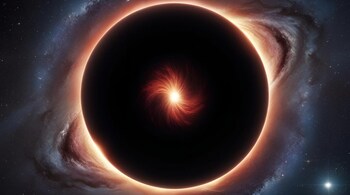
Scientists have long studied the mysteries of the universe. But a new discovery by the James Webb Space Telescope (JWST) is raising surprising questions. Could the universe itself be trapped inside a black hole? Some researchers believe this may explain a puzzling cosmic pattern.
Galaxies Spinning in the Same Direction
JWST has observed deep space since mid-2022. It has found that most distant galaxies appear to rotate the same way. Around two-thirds spin clockwise, while the rest turn counter-clockwise. Scientists expected a 50-50 split, suggesting a random universe. Instead, this pattern hints at an underlying force shaping cosmic rotation.
The study used data from the James Webb Space Telescope Advanced Deep Extragalactic Survey (JADES). Lead researcher Lior Shamir of Kansas State University shared two possible explanations. Either the universe was born rotating, or existing theories need major revisions.
A Universe Born in a Black Hole?
One theory suggests the universe formed inside a black hole. This idea, called "black hole cosmology," was first proposed decades ago. It suggests the universe exists inside a black hole from a larger cosmos. The event horizon—the point of no return—could be our cosmic boundary.
Polish physicist Nikodem Popławski has championed this idea. He suggests that black holes might create new universes. In this process, collapsing matter rebounds like a compressed spring. This could explain the Big Bang and the universe’s rapid expansion.
"A black hole's rotation influences the universe it creates," Popławski explained. If JWST confirms a preferred cosmic spin, it would support this theory.
A New Cosmic Puzzle
Another explanation could involve the Milky Way’s own rotation. Some scientists believe its motion may skew JWST’s observations. If true, cosmologists may need to adjust distance measurements. This could also solve debates about the universe’s expansion rate.
Shamir believes further study is crucial. "We need to understand if the universe has a true preferred direction," he said.
The study was published in the Monthly Notices of the Royal Astronomical Society.
Discover the latest Business News, Sensex, and Nifty updates. Obtain Personal Finance insights, tax queries, and expert opinions on Moneycontrol or download the Moneycontrol App to stay updated!





