

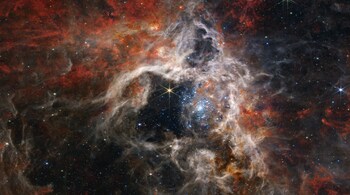
The European Space Agency (ESA) shared a mesmerising video on Thursday. The footage, captured by the Hubble telescope, highlights the Tarantula Nebula. This fascinating region lies in the Large Magellanic Cloud, a satellite galaxy of the Milky Way.
A Star-Forming Marvel in the Universe
The Tarantula Nebula is known for its active star formation. ESA calls it the "most productive star-forming region" nearby. It is home to the most massive known stars in space. Some stars are 200 times heavier than the Sun.
Located 1,60,000 light-years from Earth, the Large Magellanic Cloud is 10-20 per cent as massive as the Milky Way. The nebula features blue gas, brownish-orange dust, and stars of varying colours.
Decoding Cosmic Dust and Star Formation
ESA explained why some stars appear redder than others. Dust absorbs blue light, making stars behind it look red. Observations of this nebula could unlock insights into cosmic dust. Researchers hope to learn more about its role in forming stars and planets.
This discovery is part of ongoing efforts to study galaxies. With Hubble's observations, scientists aim to uncover secrets of the cosmos.
Discover the latest Business News, Sensex, and Nifty updates. Obtain Personal Finance insights, tax queries, and expert opinions on Moneycontrol or download the Moneycontrol App to stay updated!





