

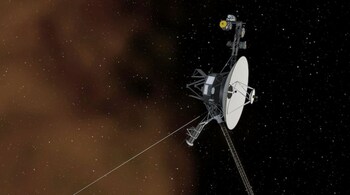
Thirty-six years ago, a distant spacecraft captured its last view. NASA’s Voyager 2 sent home an image of Neptune and its moon Triton before closing its cameras forever.
What did the final Voyager 2 image show?
On 28 August 1989, Voyager 2 looked back at Neptune from 4.7 billion kilometres away. The icy planet appeared on the left, with Triton shining faintly on the right. The probe had already passed Neptune, gazing into the dark beyond the Sun. From its position, most sunlit sides of Neptune and Triton were hidden, giving a rare parting glimpse of these distant worlds.
Why was Voyager 2’s cameras shut down?
The image marked the spacecraft’s last visual record. Soon after, NASA turned off its optical cameras to save power. The decision kept Voyager 2 alive to send other data, as its energy supply continued to fade with distance. The Neptune flyby was considered one of the craft’s defining moments.
What role did the mission play in exploration?
Voyager 2 launched in 1977 to tour the outer planets. It visited Jupiter, Saturn, Uranus, and Neptune, returning data that transformed scientific understanding. The encounter with Neptune revealed Triton’s icy geysers and its unusual retrograde orbit. After its cameras shut down, Voyager 2 began a new phase, shifting from planetary exploration to probing the far edges of interstellar space.
Discover the latest Business News, Sensex, and Nifty updates. Obtain Personal Finance insights, tax queries, and expert opinions on Moneycontrol or download the Moneycontrol App to stay updated!





