

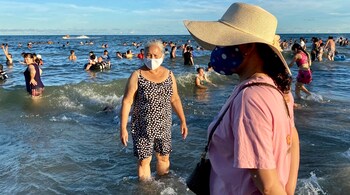
Vietnam, which had gone 100 days without reporting a case of local transmission of the coronavirus, said Saturday that a 57-year-old grandfather in the central city of Danang had tested positive. How he got the illness remains a mystery.
To prevent a wider outbreak, the Health Ministry said it was conducting “extensive screening and testing in all at-risk areas in Danang.” Officials said they had tested and quarantined people who had been in close contact with the patient and were tracing others. So far, no other positive cases have surfaced.
The case of the Danang grandfather is yet another sign of how difficult it is to contain the virus even when a country has followed the best practices. The patient has no record of recent travel and appears to be a homebody who spends most of his time looking after his grandchildren.
Health officials, noting that mask use in Vietnam had become lax, urged members of the public to resume wearing them, especially in crowded places and on public transportation.
Vietnam, one of the world’s few remaining communist states, has been among the most successful in the world in containing the virus. Soon after the illness emerged in China, Vietnam’s northern neighbor, the government quickly closed international borders, called for widespread use of masks and established strict quarantine and aggressive contact-tracing procedures.
Most foreigners are still barred from traveling to Vietnam, and returning citizens are required to go into quarantine, which is where all of Vietnam’s other recent cases have been found.
The public has embraced the campaign and rallied around one famous case, that of Scottish pilot, Stephen Cameron, 43, who came so close to death that doctors in Ho Chi Minh City contemplated giving him a double-lung transplant. He spent more than two months on life support in a medically induced coma but recovered and flew home two weeks ago.
As of Saturday, Vietnam had reported 416 cases and no deaths. Its last known case of local transmission was in mid-April. The government has been considering resuming international flights to countries where the virus has been contained.
The discovery of the new case in Danang was a shock. Many people reportedly canceled travel plans in central Vietnam, a popular destination for domestic and foreign travelers.
The 57-year-old man, known as Patient 416, first showed signs of a cough and fever July 17 and was admitted to a hospital three days later. He was initially diagnosed with pneumonia. An X-ray showed lung lesions and, after he suffered respiratory failure, he was put on a ventilator.
His tests for COVID-19 were positive from the outset, but it was not until Saturday, when the fourth test result came back, that the government officially declared that he had COVID-19, the disease caused by the coronavirus.
The country’s acting health minister, Nguyen Thanh Long, confirmed the finding at a meeting Saturday of the National Steering Committee for COVID-19.
Health investigators concluded that the patient had not traveled outside Danang, one of Vietnam’s largest cities, and had rarely left home in the month before becoming ill.
On July 7, he took his 92-year-old mother to a medical center for treatment for her heart ailment and, on July 16, visited her at the hospital where she had been transferred.
On July 17, he began to feel tired and feverish but attended an engagement party. The next day, he went to a family wedding.
Health officials said that more than 100 people with whom he had been in contact had tested negative for the virus. About 50 of them have been placed in isolation as a further precaution.
Specialist teams were sent from other parts of the country, including from Cho Ray Hospital, where Cameron was treated, to help with the treatment of Patient 416, whose condition appeared to be deteriorating.
“This patient is suffering from acute pneumonia with severe symptoms and rapid progression,” according to a statement posted Friday by the Health Ministry, and doctors were pursuing “a maximum treatment regimen.”
c.2020 The New York Times Company
Discover the latest Business News, Sensex, and Nifty updates. Obtain Personal Finance insights, tax queries, and expert opinions on Moneycontrol or download the Moneycontrol App to stay updated!





