

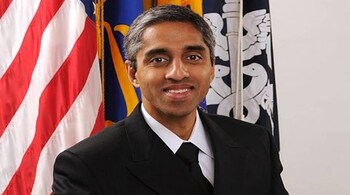
Indian-American physician Dr Vivek Murthy, US President Joe Biden's nominee to serve as America's Surgeon General, has told lawmakers that his first and foremost priority would be to turn the coronavirus pandemic around, an issue very personal to him as he lost seven family members to the deadly disease.
During his confirmation hearing by the Senate Health, Education, Labor, and Pensions Committee on Thursday, Murthy, 43, said that Americans are struggling due to the pandemic.
In his opening remarks, Murthy said that this is a moment of tremendous suffering for the nation, more than half a million people have lost their lives to COVID-19 including beloved members of his own family.
Many more are facing long-term health consequences and stressful financial struggles. If confirmed as the surgeon general my highest priority will be to help end this pandemic, he said.
I have had the privilege of serving once before. And the reason I'm back.. is because my priority, first and foremost, is to address COVID to turn this pandemic around," Murthy said.
The US has the highest coronavirus case tally in the world at 28.4 million and the highest death toll at 508,114.
"There are issues that have been worsened by COVID, mental health and substance use disorders. And those are my accompanying priorities as well. But we've got to turn this pandemic around first and foremost, Murthy told Senators during the Congressional hearing.
Responding to questions, Murthy told lawmakers that he has lost seven family members to COVID-19.
Most recently, my uncle in Dallas a few weeks ago," he said.
"I look at my children, you know, who are--my older one, my son is doing remote learning as well. Desperately wants to be back, you know, with other kids, but can't. And there are many families I know that are struggling much more than we are, he said.
Murthy said he wants families to be able to get back to their lives.
"I want our kids to be able to get back to school. I want people to be able to go to work and not worry every day that they're going to catch a virus--the virus and get sick. I want us to be able to come together as a community again," he said.
"That's what's brought me back to public service. It's why I hope to have the opportunity to serve our country once again, he said in response to a question from Senator Tommy Tuberville.
If confirmed by the Senate, Dr Murthy would for the second time occupy the position of America's Surgeon General. In 2011, President Barack Obama tapped Murthy to serve on the advisory group on prevention, health promotion, and integrative and public health. In 2013, he nominated Murthy to be America's Surgeon-General.
Responding to a question from Senator Maggie Hassan, Murthy acknowledged that a lot of Americans are experiencing fatigue from the pandemic.
I certainly am as well. I know a lot of us have been struggling for the last year, although, many certainly much, much harder, you know, have had much more difficult experiences than others, he said.
Murthy said there was a need to be consistent in the communication around the value and the importance of masks.
"...the faster we can also get people vaccinated, the more quickly we can return to a state where we can see each other, where we don't have to distance or we don't have to wear masks all the time," he said.
"That's why I would also focus my efforts on the vaccine, on getting it to people and making sure people understood clearly what the benefits and, you know, are so that they can make a decision for themselves and their families, Murthy said.
Senator Patty Murray said that Murthy is uniquely qualified to help the American people navigate the health challenges ahead of them.
One of the reasons I know Dr Murthy is the right pick to serve as surgeon general is because he's already done the job and done it well, he said.
During his last tenure as America's doctor he established himself as a trusted voice on public health issues, saw our nation through public health emergencies like the Zika epidemic in 2016, he led the charge against the opioid crisis, and he shined a light on how stress, isolation, and other mental health issues threaten America's well-being an issue that is all the more urgent given the trauma of this pandemic, Murray said.
The Senate Committee has received a record 29 letters in support of Murthy's nomination.
Murthy was born in Huddersfield, Yorkshire to immigrants from Karnataka. When he was three-year-old, the family relocated to Miami.
Discover the latest Business News, Sensex, and Nifty updates. Obtain Personal Finance insights, tax queries, and expert opinions on Moneycontrol or download the Moneycontrol App to stay updated!





