

Bobby Hernandez plans to spend his stimulus check on medication to manage his diabetes. Wilma Estrella will use hers to pay the electricity bill. Lizbeth Ramos intends to catch up on the rent, though the money will not be enough to cover all that she owes.
They are hardly alone: No state’s workforce has been battered as badly by the coronavirus pandemic as Nevada’s, and people are especially struggling in Las Vegas, a boom-and-bust city where tourist dollars and lavish tips have given way to shuttered hotels and weed-strewn parking lots.
It is hard to remember the level of optimism and exuberance that prevailed here a year ago, as presidential hopefuls traipsed through the state for the Democratic caucuses. The economy had roared back from the Great Recession, and it could seem that growth was limitless.
COVID-19 impact: A sports year like none other
Today, the grim desperation is softened only by the hope that vaccinations will bring tourists eager to celebrate and spend. Though most casinos have reopened, they have a small fraction of the tourists they once did. Many restaurants have shuttered their doors for good, and those that are open are at limited capacity.
As a result, a year into the pandemic, Las Vegas has the highest unemployment rate among large cities, with more than 10% out of work, according to the Bureau of Labor Statistics, and over the last year the workforce in Nevada has lost more income than in any other state.
For many, the only thing that cushioned the blow was the federal stimulus checks. Now more money is on the way: The $1.9 trillion relief bill that President Joe Biden signed Thursday would direct about $4 billion to the state. Vice President Kamala Harris plans to visit the city Monday, part of the administration’s effort to rally public support for the measure.
But for those scraping to get by, the promise of another stimulus payment has not relieved the anxiety of knowing that, no matter how much it helps, it will almost certainly fall short.
“I feel pretty scared every day, right now, whenever I think about my bills,” Ramos, a 32-year-old waitress, said as she loaded bags from a food pantry into her trunk on a recent afternoon. “Basically every morning I wake up thinking about where my help is going to come from — is it here? Is it the government? I don’t really know who is looking out for people like me.”
Because the economy relies so heavily on tourism and the service industry, Nevada — and Las Vegas particularly — is one of the most economically vulnerable parts of the country. The coronavirus pushed the state to an economic cliff even more dramatic than the recession did a decade ago.
Last year, the Democratic-controlled Legislature slashed some $1.2 billion from the state budget, stopping construction projects and cutting funding to the health budget. In April, Nevada registered unemployment of 29.5%, higher than in any state in any month since the Bureau of Labor Statistics started tracking state unemployment rates in 1976.
The downturn has many Nevadans scrambling to keep up. Roughly 1 million Nevada residents, some 45% of adults in the state, have fallen behind on basic household expenses, according to an analysis by the Center on Budget and Policy Priorities, a liberal research group.
One of them is MaryAnn Bautista, a single mother of five. She said she could still remember the shock she felt a year ago, when managers at the hotel where she worked told her she was being laid off. She could not hold back tears as she finished her shift at the buffet there. When a couple of customers asked if they could help, she could only shake her head.
In the last year, she has received help from her adult children, food banks and a program run by her union to help her cover one month’s rent. She receives unemployment as well.
But what Bautista wants most is the job she held for more than 17 years, which she will lose permanently unless she is called in for a shift in the next week. (Under the union contract, she is entitled to the same job and seniority if she is called back to work within a year — after that, the claim to the job evaporates.)
“I struggle so much, I lie awake in bed calculating what I can pay this time, what can wait a little longer?” she said.
Bautista is particularly pained by the fact that her teenage daughter has begun working as much as 40 hours a week at a local amusement park to try to help pay the bills.
“There’s no way out of this until I have a job,” she said. “That’s what I think every time I break down.”
Even as infection rates decline, there are signs that the economy could sour again — nearly 100,000 fewer residents in the state had jobs last month compared to February of last year. Employment is even worse for low-wage workers, dropping some 23% among residents who earn less than $27,000 a year, according to the Center for American Progress. Claims for unemployment insurance are more than triple what they were in 2019, the study found.
And it is unclear whether the glittery city will ever return to its pre-pandemic heyday. After the longtime casino magnate Sheldon Adelson died in January, his company sold off both of its Las Vegas properties, saying it would concentrate on its businesses in Asia.
“We’re in a world of hurt here in terms of Las Vegas,” Rob Goldstein, president and CEO of the company, Las Vegas Sands, said in July. “I’ve never felt more gloomy than I do today about what’s happening in Las Vegas.”
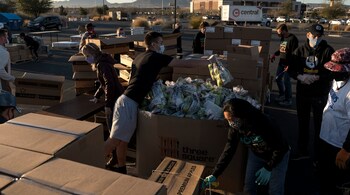
A little more than a year ago, the ballroom at the Culinary Academy of Las Vegas played host to presidential candidates, there to talk with leaders from the most powerful labor union in the state and one of the most politically powerful in the country. Today, the ballroom is covered with onion skins and dried beans, as dozens of workers pack boxes brimming with food for out-of-work union members. Roughly half of all members are still without a job — an improvement from last spring, when more than 90% of them did not have work.
“We never ever have had something like this before,” said Geoconda Argüello-Kline, the head of the union, Culinary Workers Local 226. “We have more need than ever and we have to realize this is an emergency. The Democrats always say they are for working people, so we elect them, and now we expect them to find more ways to help in this crisis.”
Late last year, Guadalupe Rodriguez left the home she had rented for more than a decade and moved into a ranch-style home with one of her co-workers from the Strat hotel. Both were laid off last March. Along with another roommate, they are cobbling together enough money to pay the mortgage and household bills. But she finds it hard not to grow angry at the government.
“I have not asked for much my entire life, but now we need the help,” Rodriguez said.
She could not receive any of the stimulus money last year, she said, because she was married at the time to an immigrant in the country illegally. This time around, she will receive a check, but in her mind it has been spent before it even arrives. “It feels like they do these things, they get attention, but the money won’t stay,” she said. “We will be hurting again tomorrow.”
The short bursts of cash from stimulus checks create a cyclical living experience, as the relief of being able to make some payments or buy food gives way to the anxiety of bills to come.
“Stimulus money shortens the line for food from a food pantry and when it evaporates, the lines get longer again,” said Larry Scott, the chief operating officer for Three Square Food Bank, the largest in Southern Nevada. “We’re going to have a protracted, long, long recovery here. What the politicians should be concentrating on is more than a short-term solution. Rather than a lot of money at a short time, we should have more money over a longer period of time.”
The pain is also disproportionately hurting those who can least afford it, sending families who were already teetering close to poverty to the streets; families living in tents now inhabit the freeway underpasses throughout the region.
Bautista, the single mother of five, knows she is one of the lucky ones. She signed up for and received unemployment checks within weeks, while some of her former co-workers were caught up in the system for months.
Typically, she has just enough to cover the roughly $2,000 she has to pay for rent, car insurance and medical bills. She has managed to send a few checks to her mother in the Philippines, as she has done for the last two decades.
“I came here to work, and I devoted my life to this community,” she said, as tears streaked her cheeks. “This is our life that we have, and we cannot always rely on handouts.”
Bautista said she would spend her stimulus money stocking up on food and helping her children out with their bills. “We appreciate the help,” she said of the government aid. “Don’t get me wrong. We do appreciate that, but we cannot rely on it. We want job assurance.”
“If I have my job, I’m not going to be scared, because I know I can deal with all of this,” she added. “I’m going to have money to pay for my bills.”
(Authors: Jennifer Medina )/(c.2021 The New York Times Company)
Discover the latest Business News, Sensex, and Nifty updates. Obtain Personal Finance insights, tax queries, and expert opinions on Moneycontrol or download the Moneycontrol App to stay updated!





