

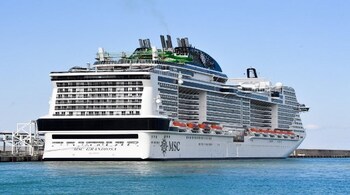
The first major cruise ship to set sail in the Mediterranean was poised to depart from Genoa on Sunday, as Italy's struggling travel industry hopes to regain ground after a bruising coronavirus hiatus.
The departure of the MSC Grandiosa from the northwestern port city at 1930 local time (1730 GMT) represents a high-stakes test for the global sector in the key Mediterranean market and beyond.
The international cruise industry has been battered not only by the ongoing health crisis which in March forced the worldwide grounding of its ships, but accusations of a botched handling of the epidemic in its early stages.
Cruise lines are hoping that new, tighter protocols will allow them to control the still-lingering threat of coronavirus aboard its ships while still offering travellers a cruise experience that does not disappoint.
The Grandiosa is part of the fleet of privately-owned MSC Cruises, founded in Naples but now based in Geneva. The ship will travel to the ports of Civitavecchia near Rome, Naples, Palermo and Valletta, Malta during the seven-day cruise.
Competitor Costa Cruises, owned by Carnival, has opted to delay the restart of its Mediterranean cruises until September, with departures from Trieste and Genoa for Italian-only clients. The company said the measure was designed to "guarantee the maximum security for guests, crew and local communities."
Fewer passengers
Much is riding on the decision to restart cruises. Italy represents the bulk of Europe's cruise industry, reaping 14.5 billion euros of revenue per year ($17 billion) and supporting nearly 53,000 jobs, according to the Cruise Lines International Association (CLIA).
The group estimated a potential economic loss from suspended cruises throughout Europe could amount to about 25.5 billion euros.
Last week, Italy's government, which is striving to revive the country's moribund economy after an over two-month lockdown, gave cruise operators the green light to begin operating again as of August 15.
MSC said that for now, its ships would sail at about 70 percent of normal passenger capacity.
All eyes in the industry will be on the Grandiosa after a smaller cruise operator, Norway's Hurtigruten, was forced earlier this month to suspend its newly restarted service after dozens of passengers and crew tested positive for COVID-19.
Global health authorities criticised the industry's slow response to the spread of the virus at the onset of the crisis earlier this year before ships were grounded in March, from lax monitoring of crew, to continued operation of self-service buffets and gyms, to lack of personal protective equipment.
Tests at terminal
As of June 11, 3,047 people were infected and 73 people died aboard 48 cruise ships affiliated with trade group Cruise Lines International Association (CLIA), according to Johns Hopkins University data provided by CLIA.
The US Centers for Disease Control, which in July extended a no-sail order in US waters until September 30, has said close living and working spaces for crew, along with partially enclosed environments, contributed to a "greater risk" of infection on cruises than in other venues.
MSC has suspended the rest of its Mediterranean cruises until October save for an August 29 cruise departing from the southern Italian port of Bari.
The company said its new security protocol exceeds national and industry standards. At the terminal before boarding, passengers and crew will be administered a COVID-19 blood test and temperatures will be taken daily. For excursions, passengers will be escorted in controlled groups to avoid interactions with others.
Food from the buffet, a highlight of the cruise experience, will be served at passengers' tables.
Follow our full coverage of the coronavirus pandemic here.
Discover the latest Business News, Sensex, and Nifty updates. Obtain Personal Finance insights, tax queries, and expert opinions on Moneycontrol or download the Moneycontrol App to stay updated!





